
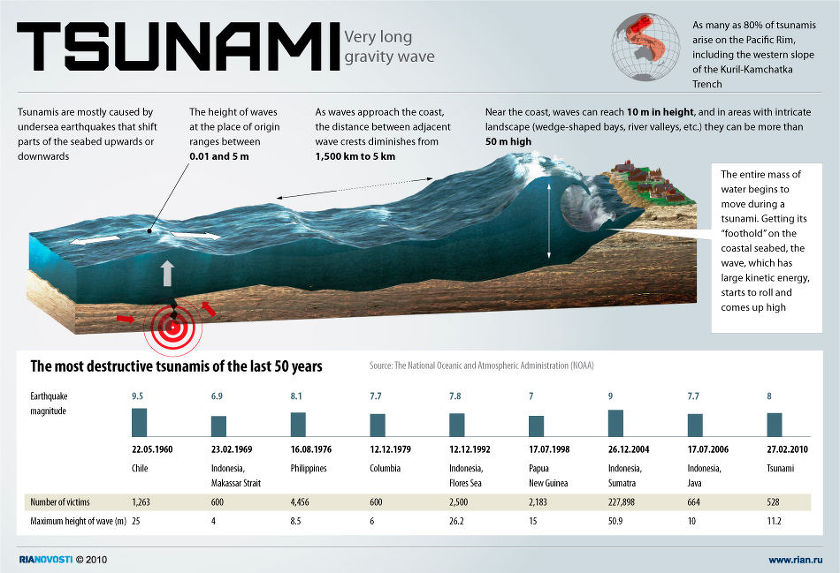
A Tsunami is a progression of water waves brought on by the dislodging of an impressive volume of a grouping of water, regularly a sea or a great pond. Quakes, volcanic ejections and different underwater outbursts (incorporating explosions of underwater atomic units), avalanches, icy mass calvings, shooting star effects and different unsettling influences above or beneath water all have the potential to produce a tsunami.
Tsunami
Related posts:
Radioactivity After Chernobyl
Indigenous origins of radiation are particularly pervasive in nature's domain, and claim roots in inestimable beams, sustenance roots (bananas have a specific elevated root), radon gas, rock and different thick shakes, and others. The group radiation underpinning measurements for characteristic roots in Europe is about 500,000 man Sieverts for each year. The aggregate measurements from Chernobyl i...
Indigenous origins of radiation are particularly pervasive in nature's domain, and claim roots in inestimable beams, sustenance roots (bananas have a specific elevated root), radon gas, rock and different thick shakes, and others. The group radiation underpinning measurements for characteristic roots in Europe is about 500,000 man Sieverts for each year. The aggregate measurements from Chernobyl i...
Ocean Garbage Patch
The Ocean Garbage Patch, discovered in 2010, is a gyre of marine litter suspended in the upper water segment of the halfway Indian Sea, specifically the Indian Sea Gyre, one of the five major sea gyres. The patch does not appear as an endless junk field. As with diverse alters in each of the five oceanic gyres, the plastics in it break down to continually minor particles, and to constituent polyme...
The Ocean Garbage Patch, discovered in 2010, is a gyre of marine litter suspended in the upper water segment of the halfway Indian Sea, specifically the Indian Sea Gyre, one of the five major sea gyres. The patch does not appear as an endless junk field. As with diverse alters in each of the five oceanic gyres, the plastics in it break down to continually minor particles, and to constituent polyme...
North American Ecology
Ecology is the science investigation of the associations that living beings have with one another and with their instinctive surroundings. Points of investment to scientists incorporate the creation, conveyance, product (biomass), number, and modifying states of living beings within and right around environments. Biological communities are made out of rapidly interfacing parts incorporating creatu...
Ecology is the science investigation of the associations that living beings have with one another and with their instinctive surroundings. Points of investment to scientists incorporate the creation, conveyance, product (biomass), number, and modifying states of living beings within and right around environments. Biological communities are made out of rapidly interfacing parts incorporating creatu...
Temperature Changes 2009 Nov
Temperature Change is a procedure in which update of temperature of a space (and protests on the whole there within) is measured or generally identified, and the section of high temperature life into or out of the space is changed in accordance with actualize a fancied midpoint temperature.
Temperature Change is a procedure in which update of temperature of a space (and protests on the whole there within) is measured or generally identified, and the section of high temperature life into or out of the space is changed in accordance with actualize a fancied midpoint temperature.
NG THe Earth's Crust
In geology, the hull is the furthest unyielding shell of a rough planet or characteristic satellite, which is artificially dissimilar from the underlying mantle. The hulls of Earth, our Moon, Mercury, Venus, Scratches, Io, and different planetary figures have been created impressively by volcanic procedures, and these outside layers are richer in inconsistent components than their separate mantles...
In geology, the hull is the furthest unyielding shell of a rough planet or characteristic satellite, which is artificially dissimilar from the underlying mantle. The hulls of Earth, our Moon, Mercury, Venus, Scratches, Io, and different planetary figures have been created impressively by volcanic procedures, and these outside layers are richer in inconsistent components than their separate mantles...
Difference Between Tsunamis and Waves
A tsunami is a progression of water waves initiated by the uprooting of an impressive volume of a group of water, ordinarily a sea or an imposing bay. Tremors, volcanic ejections and different underwater outbursts (incorporating explosions of underwater atomic apparatuses), avalanches, ice sheet calvings, shooting star effects and different aggravations above or beneath water all have the potentia...
A tsunami is a progression of water waves initiated by the uprooting of an impressive volume of a group of water, ordinarily a sea or an imposing bay. Tremors, volcanic ejections and different underwater outbursts (incorporating explosions of underwater atomic apparatuses), avalanches, ice sheet calvings, shooting star effects and different aggravations above or beneath water all have the potentia...
Kyoto Targets as of 2010
The Kyoto Targets is an order to the United Countries Schema Meeting on Atmosphere Update (UNFCCC or FCCC) that set tying commitments on the industrialised nations to diminish their outflows of nursery gases. The UNFCCC is a global natural treaty with the target of realizing the "stabilisation of nursery gas focuses in the air at a level that could avoid unsafe anthropogenic impedance with the atm...
The Kyoto Targets is an order to the United Countries Schema Meeting on Atmosphere Update (UNFCCC or FCCC) that set tying commitments on the industrialised nations to diminish their outflows of nursery gases. The UNFCCC is a global natural treaty with the target of realizing the "stabilisation of nursery gas focuses in the air at a level that could avoid unsafe anthropogenic impedance with the atm...
Climate Change
The most general definition of atmosphere update is a modification in the statistical lands of the atmosphere framework when thought about over extended periods of time, paying little mind to cause. Appropriately, vacillations over periods more limited than a few decades, for example El Niño, don't speak for atmosphere update.
The most general definition of atmosphere update is a modification in the statistical lands of the atmosphere framework when thought about over extended periods of time, paying little mind to cause. Appropriately, vacillations over periods more limited than a few decades, for example El Niño, don't speak for atmosphere update.
Continental Shifts
Continental Shift, embraced essential in mid Europe, is a quickly modifying several-movement framework that is ordinarily worked for seven days straight, following which workers are given time off, e.g. 3 mornings, 2 early evenings and after that 2 nights.
Continental Shift, embraced essential in mid Europe, is a quickly modifying several-movement framework that is ordinarily worked for seven days straight, following which workers are given time off, e.g. 3 mornings, 2 early evenings and after that 2 nights.
Soil Triangle
Soil texture is a qualitative characterization instrument utilized as a part of both the field and research center to confirm classes for farming soils dependent upon their physical texture. The classes are recognized in the field by the 'textural feel' which might be encourage elucidated by dividing the relative dimension of sand, residue and earth utilizing evaluating sifters: The Molecule Size ...
Soil texture is a qualitative characterization instrument utilized as a part of both the field and research center to confirm classes for farming soils dependent upon their physical texture. The classes are recognized in the field by the 'textural feel' which might be encourage elucidated by dividing the relative dimension of sand, residue and earth utilizing evaluating sifters: The Molecule Size ...
Indian Monsoons
A Indian Monsoons of the Indian subcontinent is around a few topographically appropriated recognitions of worldwide rainstorm happening in the Indian subcontinent. In the subcontinent, its one of most senior climate perceptions, a financially significant climate plan and the most suspected climate occasion and special climate sensation. Yet its just somewhat grasped and famously troublesome to...
A Indian Monsoons of the Indian subcontinent is around a few topographically appropriated recognitions of worldwide rainstorm happening in the Indian subcontinent. In the subcontinent, its one of most senior climate perceptions, a financially significant climate plan and the most suspected climate occasion and special climate sensation. Yet its just somewhat grasped and famously troublesome to...
Global Environmental Factors
Environmental factors are coming to be increasingly vital these days. They respect characteristic assets and the groundwork of human existence. Near these, the accesability of crude materials and power is the primary subject. As the accesability of fossil energizes, for example oil or coal, gets more awful within the subsequently decades, the reliance on the aforementioned powers stays quite unsaf...
Environmental factors are coming to be increasingly vital these days. They respect characteristic assets and the groundwork of human existence. Near these, the accesability of crude materials and power is the primary subject. As the accesability of fossil energizes, for example oil or coal, gets more awful within the subsequently decades, the reliance on the aforementioned powers stays quite unsaf...
World CO2 Emissions
A reputed organization presented information for the 2010 Worldwide Carbon Plan on December 5, 2011. Key findings are posted here: * CO2 emanations developed 5.9% in 2010 to achieve 9.1 GtC (33.5Gt CO2), conquering a 1.4% reduction in CO2 outflows in 2009 * Incorporating land-utilize update and deforestation, in 2010 emanations gotten to 10.0 GtC (36.8 Gt CO2) * As of 2009 advancing na...
A reputed organization presented information for the 2010 Worldwide Carbon Plan on December 5, 2011. Key findings are posted here: * CO2 emanations developed 5.9% in 2010 to achieve 9.1 GtC (33.5Gt CO2), conquering a 1.4% reduction in CO2 outflows in 2009 * Incorporating land-utilize update and deforestation, in 2010 emanations gotten to 10.0 GtC (36.8 Gt CO2) * As of 2009 advancing na...
Hurricanes
A Hurricane is a storm framework described by a level-force focus surrounded by a winding course of action of thunderstorms that process unyielding winds and ample rain. Tropical typhoons fortify when water dissipated from the sea is discharged as the immersed air ascents, bringing about buildup of water vapor held in the damp air. They are energized by an offbeat high temperature mechanism tha...
A Hurricane is a storm framework described by a level-force focus surrounded by a winding course of action of thunderstorms that process unyielding winds and ample rain. Tropical typhoons fortify when water dissipated from the sea is discharged as the immersed air ascents, bringing about buildup of water vapor held in the damp air. They are energized by an offbeat high temperature mechanism tha...
Cloud Types
Fogs are framed in World's climate when water vanishes into vapor from seas, ponds, lakes, and even streams and streams; or by evapotranspiration over wet regions of World's property surface. The vapor ascents up into colder ranges of the environment because of convective, orographic, or frontal lifting. The water vapor connects itself to buildup cores which might be whatever clean to minute par...
Fogs are framed in World's climate when water vanishes into vapor from seas, ponds, lakes, and even streams and streams; or by evapotranspiration over wet regions of World's property surface. The vapor ascents up into colder ranges of the environment because of convective, orographic, or frontal lifting. The water vapor connects itself to buildup cores which might be whatever clean to minute par...
Erosion
Disintegration is the procedure by which soil and shake are evacuated from the World's surface by typical courses of action for example wind or water rush, then afterward transported and saved in different areas. While disintegration is a typical process, human exercises have breathtakingly expanded (by 10-40 times) the rate at which disintegration is happening universally. Over the top disint...
Disintegration is the procedure by which soil and shake are evacuated from the World's surface by typical courses of action for example wind or water rush, then afterward transported and saved in different areas. While disintegration is a typical process, human exercises have breathtakingly expanded (by 10-40 times) the rate at which disintegration is happening universally. Over the top disint...
SC Environmental Studies (3)
The scholarly field of earthy morals acted like an adult according to the work of researchers for example Rachel Carson and occasions for example the first Earth Day in 1970, when preservationists began urging rationalists to think about the philosophical perspectives of natural situations. Two papers printed in Science had a significant effect: Lynn White's "The Recorded Bases of our Ecologic Eme...
The scholarly field of earthy morals acted like an adult according to the work of researchers for example Rachel Carson and occasions for example the first Earth Day in 1970, when preservationists began urging rationalists to think about the philosophical perspectives of natural situations. Two papers printed in Science had a significant effect: Lynn White's "The Recorded Bases of our Ecologic Eme...
Global Warming
Global Warming is the ascent in the middle temperature of World's environment and seas after the late 19th century and its extrapolated continuation. Because the early 20th century, World's mean surface temperature has expanded by about 0.8 °C (1.4 °F), with in the ballpark of two-thirds of the expand happening in light of the fact that 1980. Warming of the atmosphere framework is unequivocal,...
Global Warming is the ascent in the middle temperature of World's environment and seas after the late 19th century and its extrapolated continuation. Because the early 20th century, World's mean surface temperature has expanded by about 0.8 °C (1.4 °F), with in the ballpark of two-thirds of the expand happening in light of the fact that 1980. Warming of the atmosphere framework is unequivocal,...
 Upload your infographic here and contribute to our community.

Leave a Reply