
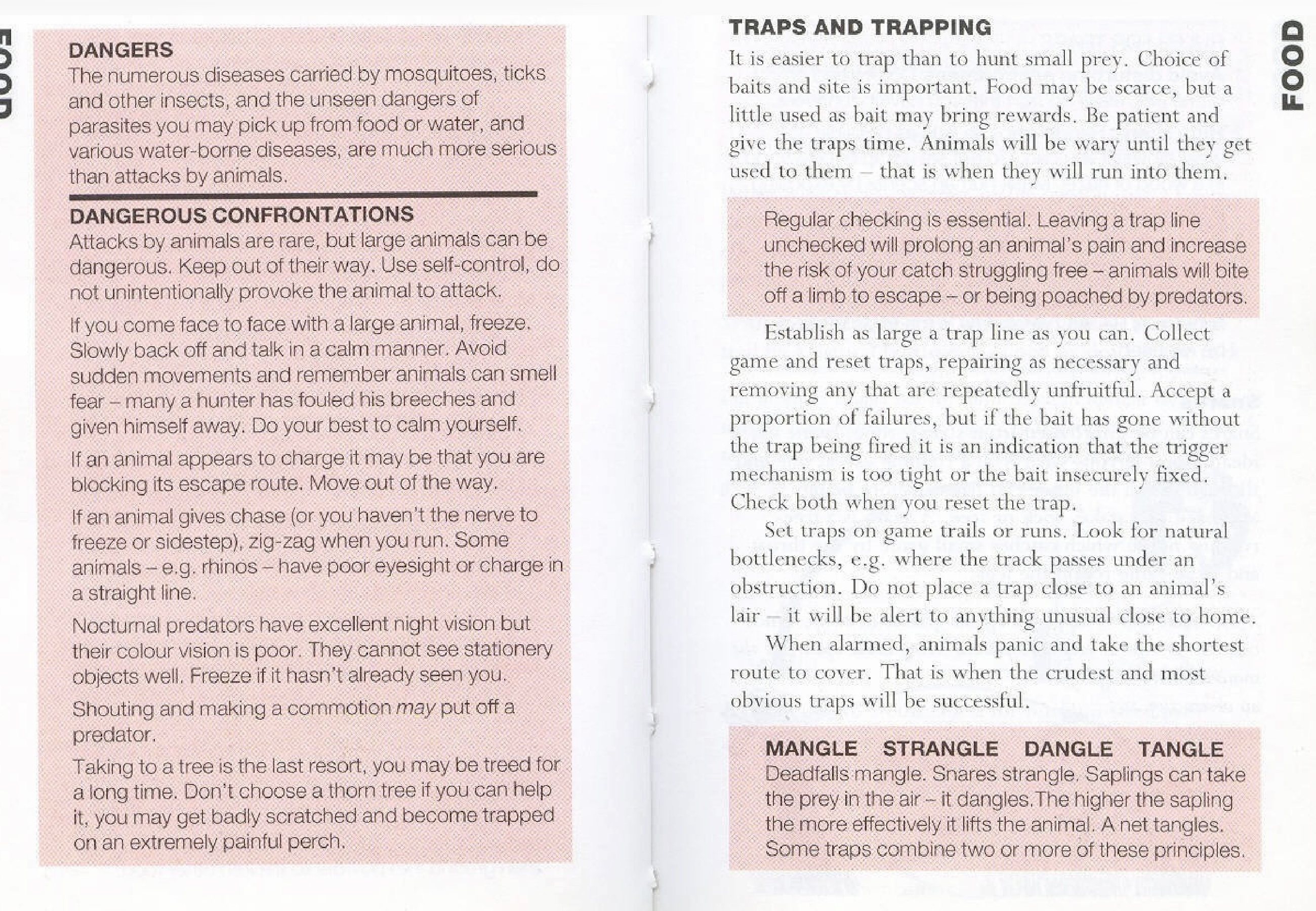
It is easier to trap than to hunt small prey. Choice of baits and site is important. Food may be scarce, but a little used as bait may bring rewards.Be patient and give the traps tim. Animals will be wary until they get used to them – that is when they will run into them.
SAS 054 – Animal Dangers & Trapping
Related posts:
SAS 069 - Fishing
When you can see fish but they are not taking bait, tie several hooks to a pole an lower it into water. Suspend a bright object 20cm above the pole, and when fish go to inspect it, pull hooks up sharply to catch them.
When you can see fish but they are not taking bait, tie several hooks to a pole an lower it into water. Suspend a bright object 20cm above the pole, and when fish go to inspect it, pull hooks up sharply to catch them.
SAS 163 - Medicinal Plants
The Fevers, Cough and colds can be cured by Camomile, Colt's Foot, Lungwort, Horehound, Yarrow, Musk mallow, Tree mallow, Marsh mallow, Great Mullein.
The Fevers, Cough and colds can be cured by Camomile, Colt's Foot, Lungwort, Horehound, Yarrow, Musk mallow, Tree mallow, Marsh mallow, Great Mullein.
SAS 119 - Moving on Waterways
A wide river will be easier to float on than to walk beside. Long-term survivors should experiment with making canoes by burning out the centre of a tree trunk or covering a frame of willow with birch bark or skins.
A wide river will be easier to float on than to walk beside. Long-term survivors should experiment with making canoes by burning out the centre of a tree trunk or covering a frame of willow with birch bark or skins.
SAS 048 - Animal Tracking
Wild cats occur on all continents except Australia and Antarctica, but not common. Secretive and generally nocturnal. Kills of big cats may be scavenged if unatteded, but beware of big cats. Small cat meat is like rabbit. Stew thoroughly.
Wild cats occur on all continents except Australia and Antarctica, but not common. Secretive and generally nocturnal. Kills of big cats may be scavenged if unatteded, but beware of big cats. Small cat meat is like rabbit. Stew thoroughly.
SAS 155 - Diseases
When in water, the survivor is more likely to be exposed to water - borne diseases, or those carried by insects and animals. Tropical diseases are less familiar and will therefore be dealt with here in more detail. Where drugs are not available, treatment is largely a matter of dealing with symptoms and making patient comfortable.
When in water, the survivor is more likely to be exposed to water - borne diseases, or those carried by insects and animals. Tropical diseases are less familiar and will therefore be dealt with here in more detail. Where drugs are not available, treatment is largely a matter of dealing with symptoms and making patient comfortable.
051 Animal Tracking
Squirrels and Prairie dogs Occur everywhere except Australasia and the Poles, hibernating in COld areas. With wallables and other relatives, limited to Australia, Large kinds can strike a powerful blow with hind feet. Most active at night. Opossums are Small nocturnal scavengers of S.America and USA. Crocodiles and Alligators are found in most subtropical and tropical areas. Avoid Large ones. Li...
Squirrels and Prairie dogs Occur everywhere except Australasia and the Poles, hibernating in COld areas. With wallables and other relatives, limited to Australia, Large kinds can strike a powerful blow with hind feet. Most active at night. Opossums are Small nocturnal scavengers of S.America and USA. Crocodiles and Alligators are found in most subtropical and tropical areas. Avoid Large ones. Li...
SAS 079 - Building Shelter
If you decide that there is no hope of rescue and it is impracticable to make your own way to safety due to distance, time of year, lack of equipment or physical condition, make a comfortable, permanent shelter.
If you decide that there is no hope of rescue and it is impracticable to make your own way to safety due to distance, time of year, lack of equipment or physical condition, make a comfortable, permanent shelter.
PS Family Disaster Plan (4)
If disaster strikes, Remain calm and Patient. Put your plan into Action.Check for injuries and give first aid and get help for seiously injured people.Listen to your battery powered radio for news and instructions. Evacuate, if advised to do so. Wear protective clothing and sturdy shoes.
If disaster strikes, Remain calm and Patient. Put your plan into Action.Check for injuries and give first aid and get help for seiously injured people.Listen to your battery powered radio for news and instructions. Evacuate, if advised to do so. Wear protective clothing and sturdy shoes.
SAS 061 - Hunting
To make a stave for hunting, select a supple want. To determine correct lenght, hold one end of staveat hip with right hand, reach sideways with left hand and mark extent of your reach as length of bow.
To make a stave for hunting, select a supple want. To determine correct lenght, hold one end of staveat hip with right hand, reach sideways with left hand and mark extent of your reach as length of bow.
PS Emergency Preparedness Checklist (3)
Get ready amaze arrangements prepared that incorporates Normal Exit track, Emergency passageway tracks, Fire Extinguisher, Smoke Detectors, Disaster supplies assortment, Doors, Collapsible Ladder and all crisis things in the Floor arrangements.
Get ready amaze arrangements prepared that incorporates Normal Exit track, Emergency passageway tracks, Fire Extinguisher, Smoke Detectors, Disaster supplies assortment, Doors, Collapsible Ladder and all crisis things in the Floor arrangements.
SAS 024 - Arid Regions
Heat causes misfortune of apetite – don't drive yourself to consume. Protein sustenance build metabolic high temperature and water misfortune. Depending on if water is rare, continue consuming to a least and attempt to consume just dampness-holding nourishments.
Heat causes misfortune of apetite – don't drive yourself to consume. Protein sustenance build metabolic high temperature and water misfortune. Depending on if water is rare, continue consuming to a least and attempt to consume just dampness-holding nourishments.
SAS 077 - Building Shelter
Atap and other large leaves when thatched make the best roofs and walls for jungle shelters. Look for any plant similarly structured, the bigger and broader the better. Closely layer halves of atap on a roof frame. Walls can be less dense.
Atap and other large leaves when thatched make the best roofs and walls for jungle shelters. Look for any plant similarly structured, the bigger and broader the better. Closely layer halves of atap on a roof frame. Walls can be less dense.
NFPA Rating Guide
The NFPA rating Explanation guide refers to the Ratings about the Health Hazards, Flammability Hazards, Instability Hazards, Rating Symbols and the Special Hazards.
The NFPA rating Explanation guide refers to the Ratings about the Health Hazards, Flammability Hazards, Instability Hazards, Rating Symbols and the Special Hazards.
SAS 028 - Food
Should stomach trouble occur, drink plenty of hot water; do not eat again until the pain goes. If it is severe, induce vomiting by tickling the back of the throat. Swallowing some charcoal will also induce vomiting and may absorb the poison at the same time.
Should stomach trouble occur, drink plenty of hot water; do not eat again until the pain goes. If it is severe, induce vomiting by tickling the back of the throat. Swallowing some charcoal will also induce vomiting and may absorb the poison at the same time.
SAS 058 - Animal Trapping
A deadfall is an ample shake or log that is tilted on a plot and kept up with areas of limbs (stays), with one of them that serves as a trigger. When the creature moves the trigger which may have trap on or close it, the rock or log falls, pounding the creature. The figure-four dead fall is an in vogue and basic trap built from materials recognized in the hedge.
A deadfall is an ample shake or log that is tilted on a plot and kept up with areas of limbs (stays), with one of them that serves as a trigger. When the creature moves the trigger which may have trap on or close it, the rock or log falls, pounding the creature. The figure-four dead fall is an in vogue and basic trap built from materials recognized in the hedge.
SAS 103 - Knots
SAS 128 - Sea Survival & Fishing
The survival at sea is vulnerable to shark attack. Ocean sharks are not usually ferocious when food is plentiful. Most are cowards and can be scared off by the jab of a stick, especially on the nose. However, makinga commotion may attract sharks. Sharks feed off the ocean bottom, but hungry sharks will follow fish to the surface and into shallow water.
The survival at sea is vulnerable to shark attack. Ocean sharks are not usually ferocious when food is plentiful. Most are cowards and can be scared off by the jab of a stick, especially on the nose. However, makinga commotion may attract sharks. Sharks feed off the ocean bottom, but hungry sharks will follow fish to the surface and into shallow water.
SAS 164 - Bites & Stings
The Bites and Strings creatures are not a major problem but should be treated with respect. The image in the post describes various curing options for most of the animals and insects.
The Bites and Strings creatures are not a major problem but should be treated with respect. The image in the post describes various curing options for most of the animals and insects.
 Upload your infographic here and contribute to our community.
Leave a Reply