
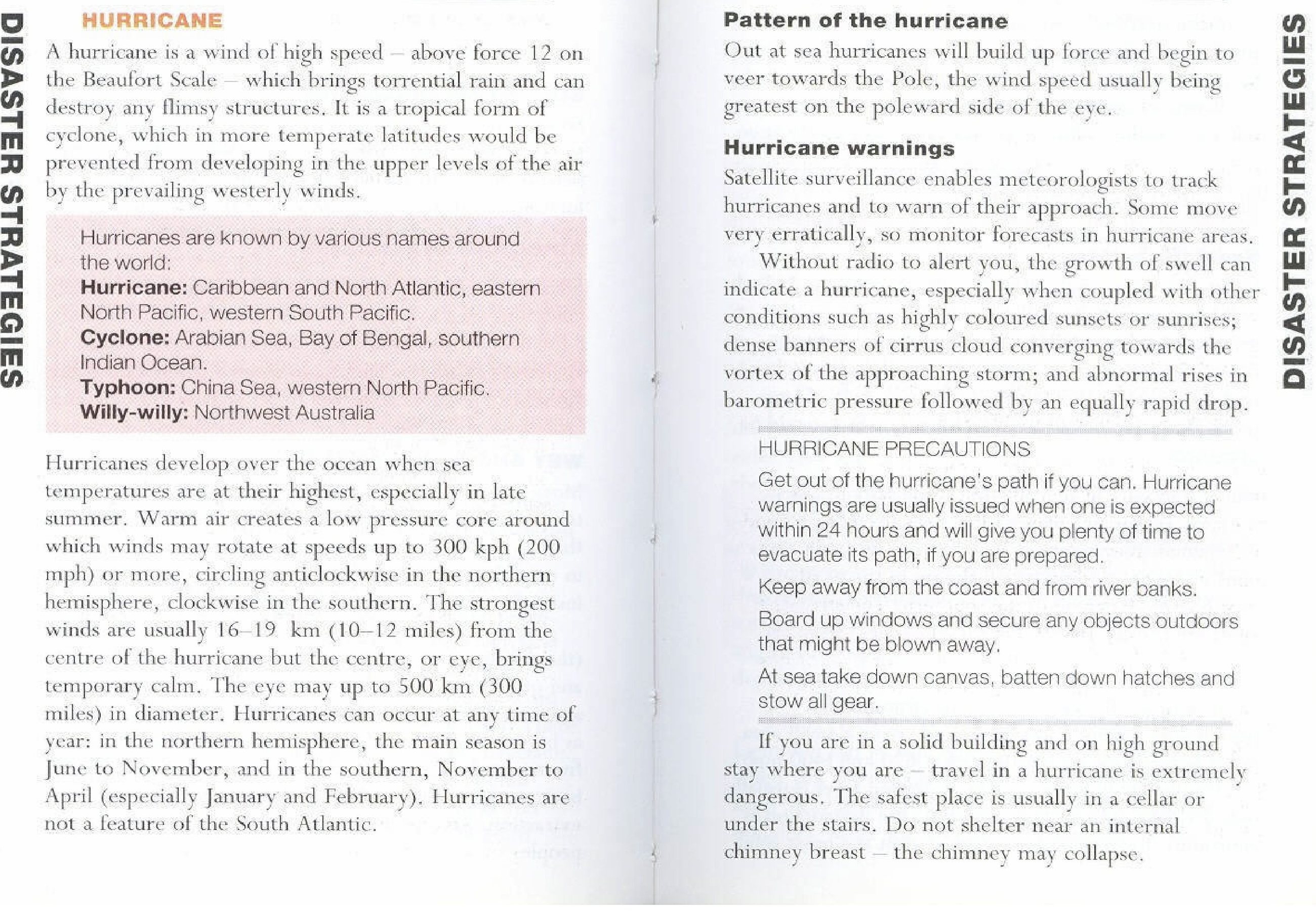
A hurricane is a wind of high speed – above force 12 on the Beaufort scale – which brings torrential rain and can destroy any flimsy structures. It is a tropical form of cyclone, which in more temperate latitudes would be prevented from developing in the upper levels of the air by the prevailing westerly winds.
SAS 179 – Disaster Strategy & Hurricane
Related posts:
SAS 176 - Disaster Strategy, Fire & Flood
Aeroplanes are equipped with automatic extinguishers for engine fires and hand held extinguishers in the cabin. Action should be taken immediately. On civil airlines summon a flight attendant immediately you suspect fire - the staff know where equipment is and how to use it.
Aeroplanes are equipped with automatic extinguishers for engine fires and hand held extinguishers in the cabin. Action should be taken immediately. On civil airlines summon a flight attendant immediately you suspect fire - the staff know where equipment is and how to use it.
PS Family Disaster Plan (6)
Learn the types of natural disasters in your region. Local Emergency management or civil denense officials can identify which disasters are most liekly to hit your community.Identify which human-caused or technological disasters can affect your region
Learn the types of natural disasters in your region. Local Emergency management or civil denense officials can identify which disasters are most liekly to hit your community.Identify which human-caused or technological disasters can affect your region
Finding South
If you are in the southern hemisphere, you would point 12 o clock at the sun but still split the difference between 12 and the hour hand for north. Also, if you practice daylight saving time, you should subtact one hour from the hour hand.
If you are in the southern hemisphere, you would point 12 o clock at the sun but still split the difference between 12 and the hour hand for north. Also, if you practice daylight saving time, you should subtact one hour from the hour hand.
051 Animal Tracking
Squirrels and Prairie dogs Occur everywhere except Australasia and the Poles, hibernating in COld areas. With wallables and other relatives, limited to Australia, Large kinds can strike a powerful blow with hind feet. Most active at night. Opossums are Small nocturnal scavengers of S.America and USA. Crocodiles and Alligators are found in most subtropical and tropical areas. Avoid Large ones. Li...
Squirrels and Prairie dogs Occur everywhere except Australasia and the Poles, hibernating in COld areas. With wallables and other relatives, limited to Australia, Large kinds can strike a powerful blow with hind feet. Most active at night. Opossums are Small nocturnal scavengers of S.America and USA. Crocodiles and Alligators are found in most subtropical and tropical areas. Avoid Large ones. Li...
SAS 124 - Sea Survival
Survival Afloat: Rafts, boats and dinghies are built to carry a limited number. These numbers should not be exceeded. Place infants and the infirm aboard, and as many able-boclied as can be accomodated. The rest must hang on in the water, frequently swopping places with fit survivors in the raft.
Survival Afloat: Rafts, boats and dinghies are built to carry a limited number. These numbers should not be exceeded. Place infants and the infirm aboard, and as many able-boclied as can be accomodated. The rest must hang on in the water, frequently swopping places with fit survivors in the raft.
SAS 096 - Camp Tools & Animal Products
Skins and Furs: Properly prepared skins ae supple, strong, and resist tearing. They have good thermal insulation, and are permeable to air and water vapour. For moccasins, shelters, laces, thongs, water bags or canoes, the fur is removed, but for warm clothing, bedding or a good insulating groundsheet is should be left on.
Skins and Furs: Properly prepared skins ae supple, strong, and resist tearing. They have good thermal insulation, and are permeable to air and water vapour. For moccasins, shelters, laces, thongs, water bags or canoes, the fur is removed, but for warm clothing, bedding or a good insulating groundsheet is should be left on.
SAS 178 - Disaster Strategy, Flood, Tsunami & Avalanche
A tsunami or tidal wave is linked with an earthquake beneath the ocean, creating a series of waves which can reach more than 30m. Not all earthquakes cause tsunami, but any earthquake could.
A tsunami or tidal wave is linked with an earthquake beneath the ocean, creating a series of waves which can reach more than 30m. Not all earthquakes cause tsunami, but any earthquake could.
SAS 147 - First Aid & Fractures
Types of Fracture: If no medical help is expected, reduce closed fractures as soon as possible after injury by applying traction, then splint and immobilise the whole length of the limb. Splints can be pieces of wood, rools of newspaper, ski sticks, etc.
Types of Fracture: If no medical help is expected, reduce closed fractures as soon as possible after injury by applying traction, then splint and immobilise the whole length of the limb. Splints can be pieces of wood, rools of newspaper, ski sticks, etc.
SAS 157 - Diseases
Some of the cold climate hazards are Hypothermia. Loss of temperature due to exposure, brought on by exhaustion, inadequate clothing or shelter, lack of food, lack of knowledge and preperation. Wet clothing or immersion in cold water will aggravate it, as will anxiety, stress and injuries that immobilise.
Some of the cold climate hazards are Hypothermia. Loss of temperature due to exposure, brought on by exhaustion, inadequate clothing or shelter, lack of food, lack of knowledge and preperation. Wet clothing or immersion in cold water will aggravate it, as will anxiety, stress and injuries that immobilise.
SAS 029 - Food
Gathering plants is one of the tedious tasks to identify place for food. Gather plants systematically. Take a container on foraging trips to stp the harvest being crushed, which makes it go off.
Gathering plants is one of the tedious tasks to identify place for food. Gather plants systematically. Take a container on foraging trips to stp the harvest being crushed, which makes it go off.
How to Jump from a Moving Car
Flinging yourself from a moving auto ought to be a final resort, for instance if your brakes are flawed and your auto is going to take off a bluff or into an entourage. Apply the crisis brake. This should not stop the auto, at the same time it may back it off enough to make bouncing safer.
Flinging yourself from a moving auto ought to be a final resort, for instance if your brakes are flawed and your auto is going to take off a bluff or into an entourage. Apply the crisis brake. This should not stop the auto, at the same time it may back it off enough to make bouncing safer.
SAS 103 - Knots
SAS 092 - Organising Camp
Camp Discipline: Do not plan amusement in camp: drain, gut and skin on the trap line to pull in event to traps, not to the camp.
Camp Discipline: Do not plan amusement in camp: drain, gut and skin on the trap line to pull in event to traps, not to the camp.
SAS 140 - First Aid & Mouth to Mouth
Artificial Respiration: With any form of resucitation the first five minutes are the most critical, but if breathing does not start, keep artificial respiration up for at least an hour. In a group, take turns. Dont give up !
Artificial Respiration: With any form of resucitation the first five minutes are the most critical, but if breathing does not start, keep artificial respiration up for at least an hour. In a group, take turns. Dont give up !
SAS 080 - Building Shelter & Fire
Fire is crucial to survival. It furnishes warmth, security and a method of signalling; it bubbles water, cooks and jam nourishment; it warms metal to make instruments and prepare pots. You should memorize to light a blaze at whatever place under any conditions. It is not enough to know every last trace of the techniques – you need to be master at them.
Fire is crucial to survival. It furnishes warmth, security and a method of signalling; it bubbles water, cooks and jam nourishment; it warms metal to make instruments and prepare pots. You should memorize to light a blaze at whatever place under any conditions. It is not enough to know every last trace of the techniques – you need to be master at them.
SAS 003 - Survival Kit
Make sure you prepare a checklist that contains Equipments for Clothes, Sleeping Bags, Backpack, Stowing Kit, Radio kit and everything pertaining to Vehicles.
Make sure you prepare a checklist that contains Equipments for Clothes, Sleeping Bags, Backpack, Stowing Kit, Radio kit and everything pertaining to Vehicles.
Survival Tips A
Shipwreck causes mainly dude to improper outline, shamefully stowed freight, route and different human slips heading to impacts (with a different send, the shoreline, a chunk of ice, and so on.), regretful climate, fiery breakout, and different creates can lead to coincidental sinkings. Purposeful purposes behind sinking a boat incorporate shaping a manufactured reef; because of warfare, robbery, ...
Shipwreck causes mainly dude to improper outline, shamefully stowed freight, route and different human slips heading to impacts (with a different send, the shoreline, a chunk of ice, and so on.), regretful climate, fiery breakout, and different creates can lead to coincidental sinkings. Purposeful purposes behind sinking a boat incorporate shaping a manufactured reef; because of warfare, robbery, ...
PS Family Disaster Plan (7)
Some of the Tips to survive with a family disaster plan are to Conduct a home hazard hunt by identifying the objects in the house that could be dangerous in an emergency. Take a first aid and CPR class.Have enough disaster supplies on hand. Develop an emergency communication plan. make arrangements for your pets as part of your household
Some of the Tips to survive with a family disaster plan are to Conduct a home hazard hunt by identifying the objects in the house that could be dangerous in an emergency. Take a first aid and CPR class.Have enough disaster supplies on hand. Develop an emergency communication plan. make arrangements for your pets as part of your household
 Upload your infographic here and contribute to our community.

Leave a Reply