
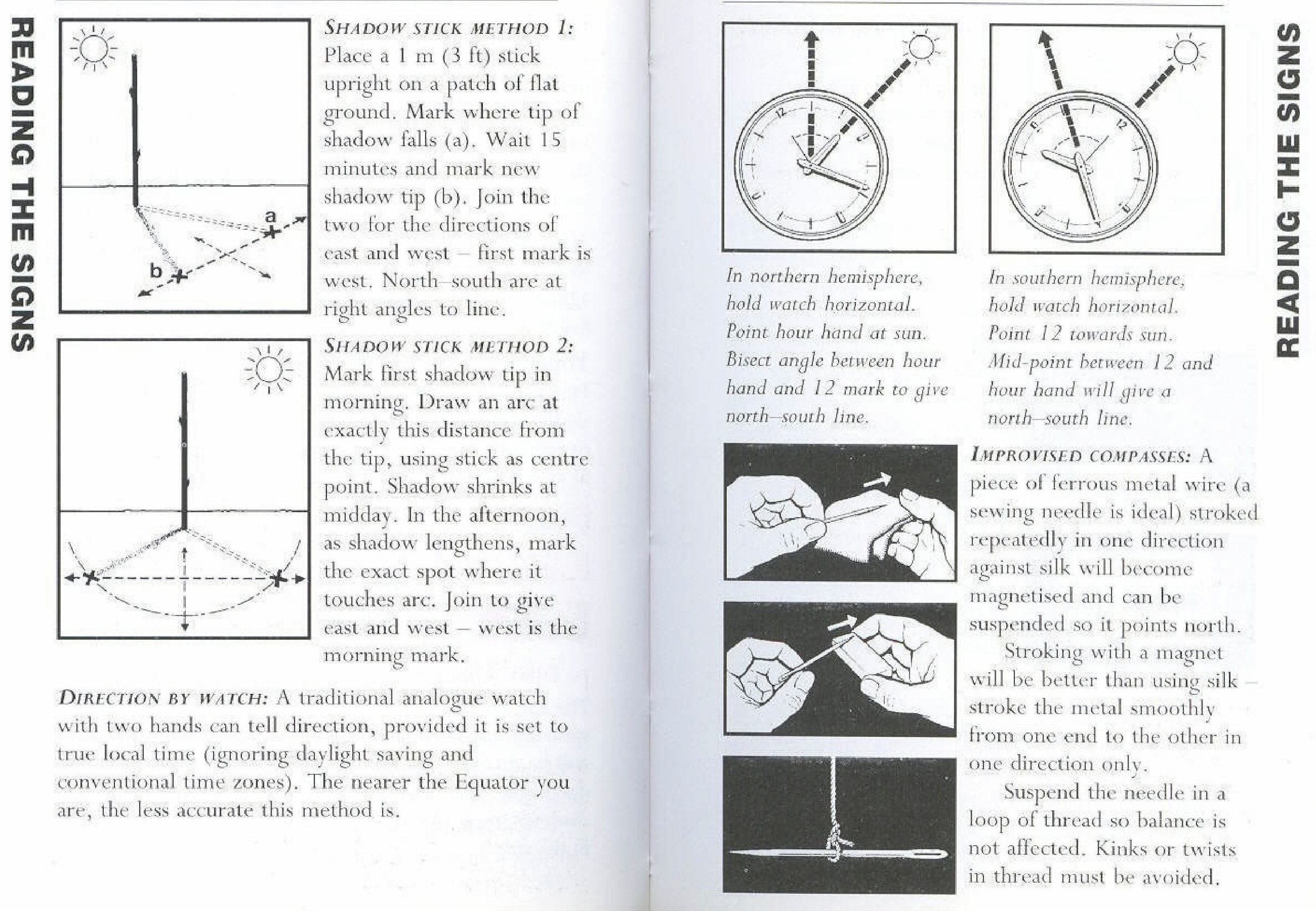
Direction by Watch: a traditional analogue watch with two hands can tell direction, provided it is set to true local time. The nearer the Equator you are, the less accurate this method is.
SAS 109 – Direction Finding
Related posts:
PS Family Disaster Plan (7)
Some of the Tips to survive with a family disaster plan are to Conduct a home hazard hunt by identifying the objects in the house that could be dangerous in an emergency. Take a first aid and CPR class.Have enough disaster supplies on hand. Develop an emergency communication plan. make arrangements for your pets as part of your household
Some of the Tips to survive with a family disaster plan are to Conduct a home hazard hunt by identifying the objects in the house that could be dangerous in an emergency. Take a first aid and CPR class.Have enough disaster supplies on hand. Develop an emergency communication plan. make arrangements for your pets as part of your household
SAS 178 - Disaster Strategy, Flood, Tsunami & Avalanche
A tsunami or tidal wave is linked with an earthquake beneath the ocean, creating a series of waves which can reach more than 30m. Not all earthquakes cause tsunami, but any earthquake could.
A tsunami or tidal wave is linked with an earthquake beneath the ocean, creating a series of waves which can reach more than 30m. Not all earthquakes cause tsunami, but any earthquake could.
SAS 147 - First Aid & Fractures
Types of Fracture: If no medical help is expected, reduce closed fractures as soon as possible after injury by applying traction, then splint and immobilise the whole length of the limb. Splints can be pieces of wood, rools of newspaper, ski sticks, etc.
Types of Fracture: If no medical help is expected, reduce closed fractures as soon as possible after injury by applying traction, then splint and immobilise the whole length of the limb. Splints can be pieces of wood, rools of newspaper, ski sticks, etc.
Nerve Points
The High Section of the Nerve points consists of the Jaw, the Front of Shoulder Muscle and the middle section contains the Biceps the Forearm Muscle and the Back of the hands. The image pictorially explains the Nerve points.
The High Section of the Nerve points consists of the Jaw, the Front of Shoulder Muscle and the middle section contains the Biceps the Forearm Muscle and the Back of the hands. The image pictorially explains the Nerve points.
SAS 180 - Disaster Strategy, Hurricane, Tornado & Lightning
Tornado Precautions: Take shelter in the most solid structure available ideally in a storm cellar or cave. In a cellar stay close to an outside wall, or in a specially reinforced section. If there is no basement, go to the centre of the lowest floor, into a small room or shelter under study furniture.
Tornado Precautions: Take shelter in the most solid structure available ideally in a storm cellar or cave. In a cellar stay close to an outside wall, or in a specially reinforced section. If there is no basement, go to the centre of the lowest floor, into a small room or shelter under study furniture.
SAS 080 - Building Shelter & Fire
Fire is crucial to survival. It furnishes warmth, security and a method of signalling; it bubbles water, cooks and jam nourishment; it warms metal to make instruments and prepare pots. You should memorize to light a blaze at whatever place under any conditions. It is not enough to know every last trace of the techniques – you need to be master at them.
Fire is crucial to survival. It furnishes warmth, security and a method of signalling; it bubbles water, cooks and jam nourishment; it warms metal to make instruments and prepare pots. You should memorize to light a blaze at whatever place under any conditions. It is not enough to know every last trace of the techniques – you need to be master at them.
SAS 002 - Equipment
Here are a portion of the things to work toward getting made due throughout any debacle. Matches ideally waterprrof, Candle which is shaved square for pressing, Flint, Magnifying glass, needles and string, fish catches and line and a compass which is fluid-filled sort with radiant catch is best.
Here are a portion of the things to work toward getting made due throughout any debacle. Matches ideally waterprrof, Candle which is shaved square for pressing, Flint, Magnifying glass, needles and string, fish catches and line and a compass which is fluid-filled sort with radiant catch is best.
Finding Direction
Direction finding points to the foundation of the course from which an appropriated sign was transmitted. This can point to radio or different manifestations of satellite correspondence. By joining together the bearing qualified information from two or suitably divided recipients (or a lone portable recipient), the root of a transmission may be found in space through triangulation.
Direction finding points to the foundation of the course from which an appropriated sign was transmitted. This can point to radio or different manifestations of satellite correspondence. By joining together the bearing qualified information from two or suitably divided recipients (or a lone portable recipient), the root of a transmission may be found in space through triangulation.
SAS 125 - Sea Survival & Signalling
How to Signal at Sea ? Use flares, dye markers and movement of any kind to attract attention at sea. If you have no signalling equipment, wave clothing or tarpauliins and churn the water if it is still. At night or in fog use a whistle to maintain contact with other survivors.
How to Signal at Sea ? Use flares, dye markers and movement of any kind to attract attention at sea. If you have no signalling equipment, wave clothing or tarpauliins and churn the water if it is still. At night or in fog use a whistle to maintain contact with other survivors.
Spotting a Hidden Handgun
The image in the post depicts how to use a hindered gun and how to fire from it.
The image in the post depicts how to use a hindered gun and how to fire from it.
SAS 028 - Food
Should stomach trouble occur, drink plenty of hot water; do not eat again until the pain goes. If it is severe, induce vomiting by tickling the back of the throat. Swallowing some charcoal will also induce vomiting and may absorb the poison at the same time.
Should stomach trouble occur, drink plenty of hot water; do not eat again until the pain goes. If it is severe, induce vomiting by tickling the back of the throat. Swallowing some charcoal will also induce vomiting and may absorb the poison at the same time.
SAS 091 - Preserving Food & Organising Camp
Assuming that no charge structure exists between an aggregation of survivors, build an organising board with specific obligations. A program is crucial for every day tasks.
Assuming that no charge structure exists between an aggregation of survivors, build an organising board with specific obligations. A program is crucial for every day tasks.
SAS 174 - Disaster Strategy & Fire
Stay in a Vehicle: Do not try to drive through thick smoke. If caught in a fire in a vehicle, park in a clear area. Pull off the road, but do not risk getting bogged down. Turn on the headlights and stay inside the car. Wind windows tightly shut.
Stay in a Vehicle: Do not try to drive through thick smoke. If caught in a fire in a vehicle, park in a clear area. Pull off the road, but do not risk getting bogged down. Turn on the headlights and stay inside the car. Wind windows tightly shut.
SAS 130 - Rescue & Signalling
Siting the signals: Take account of the terrain. Choose high points for light signals. Erect an unusual silhouette or a ridge to attract attention. Planes fly over hilly territory from the lower to the higher ridges, so slopes behind ridges may be hidden as the plan approaches. Signals near tops of ridges should be seen from any direction.
Siting the signals: Take account of the terrain. Choose high points for light signals. Erect an unusual silhouette or a ridge to attract attention. Planes fly over hilly territory from the lower to the higher ridges, so slopes behind ridges may be hidden as the plan approaches. Signals near tops of ridges should be seen from any direction.
PS Family Supply Kit (3)
Store your kit in a convenient place known to all family members. Keep a smaller verstion of the Disaster Supplies Kit in the trunk of your car. keep items in air tight plastic bags. Change your stored water supply every six months so it stays fresh.
Store your kit in a convenient place known to all family members. Keep a smaller verstion of the Disaster Supplies Kit in the trunk of your car. keep items in air tight plastic bags. Change your stored water supply every six months so it stays fresh.
Wigwam
Wigwams take more time to build than open shelters, but your efforts will be doubly rewarded. Not only can the shelter be warmed by a small fire, reducing the need to collect a huge pile of wood, but the firelight reflects off the walls, providing cheery illumination for sitting out a long winter night.
Wigwams take more time to build than open shelters, but your efforts will be doubly rewarded. Not only can the shelter be warmed by a small fire, reducing the need to collect a huge pile of wood, but the firelight reflects off the walls, providing cheery illumination for sitting out a long winter night.
SAS 165 - Poisonous Snakes
Poisonous snakes: Safety rules Don't methodology, incite or handle snakes – regardless of the fact that they appear to be dead. Some just move to strike when prey is close-and they can strike speedier than you can.
Poisonous snakes: Safety rules Don't methodology, incite or handle snakes – regardless of the fact that they appear to be dead. Some just move to strike when prey is close-and they can strike speedier than you can.
Survival Tips B
 Upload your infographic here and contribute to our community.
Leave a Reply