
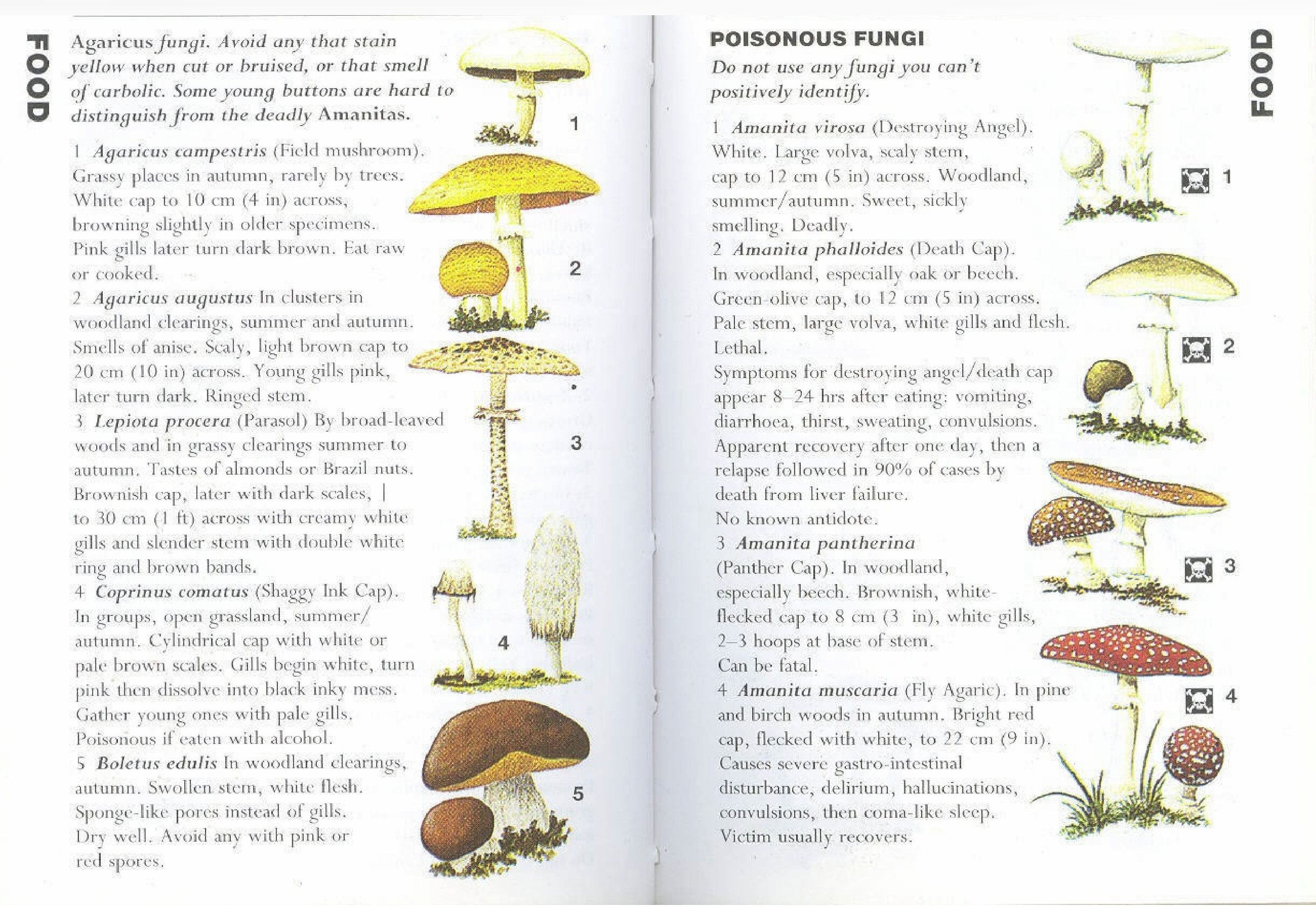
Agaricus fungi: Avoid any that stain yellow when cut or bruised, or that smell of carbolic. Some young buttons are hard to distinguish from the deadly Amanitas. Dont Use any fungi you cant positively identify.
SAS 040 – Fungi
Related posts:
SAS 005 - Survival Kits & Knives
Items like Messtin, Pencil-Sized Torch, Marker Panel, Matches, Brew Kit, Food, Survival Bag makes a survival kit complete. Ideally all these items are mandatory to be on a safer side when a disaster takes place.
Items like Messtin, Pencil-Sized Torch, Marker Panel, Matches, Brew Kit, Food, Survival Bag makes a survival kit complete. Ideally all these items are mandatory to be on a safer side when a disaster takes place.
Surviving a Thunderstorm
To survive from a thunderstorm, do not take cover under the tree's or any other wooden structure. If struck by lightning, they will effectively explode and you will be trapped under a fiery tree of death. On top of that, you will probably have quite a few big splinters.
To survive from a thunderstorm, do not take cover under the tree's or any other wooden structure. If struck by lightning, they will effectively explode and you will be trapped under a fiery tree of death. On top of that, you will probably have quite a few big splinters.
SAS 158 - Diseases & Natural Medicine
Natural medicine or Natural remedies can be used when medical supplies are exhausted, or to supplement your store. Urine can be used as an antiseptic to wash out wounds. Maggots will keep a wound open and clean until better treatment can be given.
Natural medicine or Natural remedies can be used when medical supplies are exhausted, or to supplement your store. Urine can be used as an antiseptic to wash out wounds. Maggots will keep a wound open and clean until better treatment can be given.
SAS 143 - First Aid, CPR & Bleeding
Arterial bleeding: Speed is vital in stopping blood spurting from an artery. Compress the artery at pressure points where it runs ear the surface over a bone. Watch the wound: if blood flow does not lessen, move your fingers until it does.
Arterial bleeding: Speed is vital in stopping blood spurting from an artery. Compress the artery at pressure points where it runs ear the surface over a bone. Watch the wound: if blood flow does not lessen, move your fingers until it does.
SAS 003 - Survival Kit
Make sure you prepare a checklist that contains Equipments for Clothes, Sleeping Bags, Backpack, Stowing Kit, Radio kit and everything pertaining to Vehicles.
Make sure you prepare a checklist that contains Equipments for Clothes, Sleeping Bags, Backpack, Stowing Kit, Radio kit and everything pertaining to Vehicles.
PS Family Disaster Plan (4)
If disaster strikes, Remain calm and Patient. Put your plan into Action.Check for injuries and give first aid and get help for seiously injured people.Listen to your battery powered radio for news and instructions. Evacuate, if advised to do so. Wear protective clothing and sturdy shoes.
If disaster strikes, Remain calm and Patient. Put your plan into Action.Check for injuries and give first aid and get help for seiously injured people.Listen to your battery powered radio for news and instructions. Evacuate, if advised to do so. Wear protective clothing and sturdy shoes.
SAS 153 - First Aid, Emergency Childbirth & Bites
Dangers from infection is the main risk. Anti-tetanus shots and rabies vaccine should be obtained before travelling. Rabies is untreatable without vaccine and almost always fatal.
Dangers from infection is the main risk. Anti-tetanus shots and rabies vaccine should be obtained before travelling. Rabies is untreatable without vaccine and almost always fatal.
SAS 027 - Food Values
A healthy body can survive on reserves stored in its tissues, but food is needed to supply heat and energy, and to recover after hard work, injury or sickness. Seventy calories per hour are required just for breathing and basic bodily functions.
A healthy body can survive on reserves stored in its tissues, but food is needed to supply heat and energy, and to recover after hard work, injury or sickness. Seventy calories per hour are required just for breathing and basic bodily functions.
Home Gas Mask
A gas mask is a veil put on over the appearance to secure the wearer from breathing airborne toxins and dangerous gases. The cover shapes a fixed blanket over the nose and mouth, however may in addition blanket the eyes and different helpless delicate tissues of the countenance. Certain gas veils are moreover respirators, however the statement gas veil is regularly awhile back would point to milit...
A gas mask is a veil put on over the appearance to secure the wearer from breathing airborne toxins and dangerous gases. The cover shapes a fixed blanket over the nose and mouth, however may in addition blanket the eyes and different helpless delicate tissues of the countenance. Certain gas veils are moreover respirators, however the statement gas veil is regularly awhile back would point to milit...
SAS 116 - Moving
To make a sledge that is ideal for snow and ice, use doors and cowlings from a crashed vehicle or plane in construction. Tie lines to front runners with a bowline to the people hauling - ideally two at the fron and two at the rear.
To make a sledge that is ideal for snow and ice, use doors and cowlings from a crashed vehicle or plane in construction. Tie lines to front runners with a bowline to the people hauling - ideally two at the fron and two at the rear.
SAS 122 - Sea Survival & Abandoning Ships
Survival at Sea: Four-Fifths of the Earth's surface is open water - the most difficult environment in which to survive. Water and wind rapidly chill the body. Alone in cold water your chances are not good without equipment. If you know your location you may be able to predict where the currents will carry you.
Survival at Sea: Four-Fifths of the Earth's surface is open water - the most difficult environment in which to survive. Water and wind rapidly chill the body. Alone in cold water your chances are not good without equipment. If you know your location you may be able to predict where the currents will carry you.
SAS 028 - Food
Should stomach trouble occur, drink plenty of hot water; do not eat again until the pain goes. If it is severe, induce vomiting by tickling the back of the throat. Swallowing some charcoal will also induce vomiting and may absorb the poison at the same time.
Should stomach trouble occur, drink plenty of hot water; do not eat again until the pain goes. If it is severe, induce vomiting by tickling the back of the throat. Swallowing some charcoal will also induce vomiting and may absorb the poison at the same time.
SAS 167 - Poisonous Snakes
Survival from the deadliest snakes like Cobra, Mamba, Boomslang, Krait, Death Adder, Australian black snake, Eastern brown snake, Tiger snake are very difficult indeed.
Survival from the deadliest snakes like Cobra, Mamba, Boomslang, Krait, Death Adder, Australian black snake, Eastern brown snake, Tiger snake are very difficult indeed.
SAS 007 - Facing Disaster & Water
It is no use of giving up when a disaster takes place. Only positive action can save you. People can survive seemingly impossible situations if they have the determination. Self-confidence is a product of good training ad sound knowledge. These must be acquired before you face a survival situation .
It is no use of giving up when a disaster takes place. Only positive action can save you. People can survive seemingly impossible situations if they have the determination. Self-confidence is a product of good training ad sound knowledge. These must be acquired before you face a survival situation .
SAS 074 - Building Shelter
A shelter is more agreeable in the event that it is sufficiently high to sit in, so grow it is stature by manufacturing a level divider of stones adjust your empty. Caulk between the stones with turf and foliage jumbled with mud.
A shelter is more agreeable in the event that it is sufficiently high to sit in, so grow it is stature by manufacturing a level divider of stones adjust your empty. Caulk between the stones with turf and foliage jumbled with mud.
Surveillance & Privacy
Surveillance and privacy chart depicts the various rankins of protections and Surveillances that are made in different countries.
Surveillance and privacy chart depicts the various rankins of protections and Surveillances that are made in different countries.
SAS 033 - Edible Plants
Roots are starchiest between autumn and spring. All roots should be thoroughly cooked. Scrub in clean water, boil until soft, then roast on hot stones in embers. To cook more rapidly, cut into cubes. Use a sharpened stick to test if they are done.
Roots are starchiest between autumn and spring. All roots should be thoroughly cooked. Scrub in clean water, boil until soft, then roast on hot stones in embers. To cook more rapidly, cut into cubes. Use a sharpened stick to test if they are done.
SAS 111 - Direction Finding
Using the stars in Direction Finding: The stars stay in the same relation to one another. Thier passage over the horizon starts 4 minutes earlier each night - a 2 hour difference over a mouth. In the northern hemisphere groups of stars remain visible throughout the night, wheeling round the only star that does not seem to move.
Using the stars in Direction Finding: The stars stay in the same relation to one another. Thier passage over the horizon starts 4 minutes earlier each night - a 2 hour difference over a mouth. In the northern hemisphere groups of stars remain visible throughout the night, wheeling round the only star that does not seem to move.
 Upload your infographic here and contribute to our community.
Leave a Reply