
During the hunting process, Waste Nothing, make use of parts you cannot eat. Set about preparing the kill in four stages that is: Bleeding, Skinning, Gutting and Jointing.
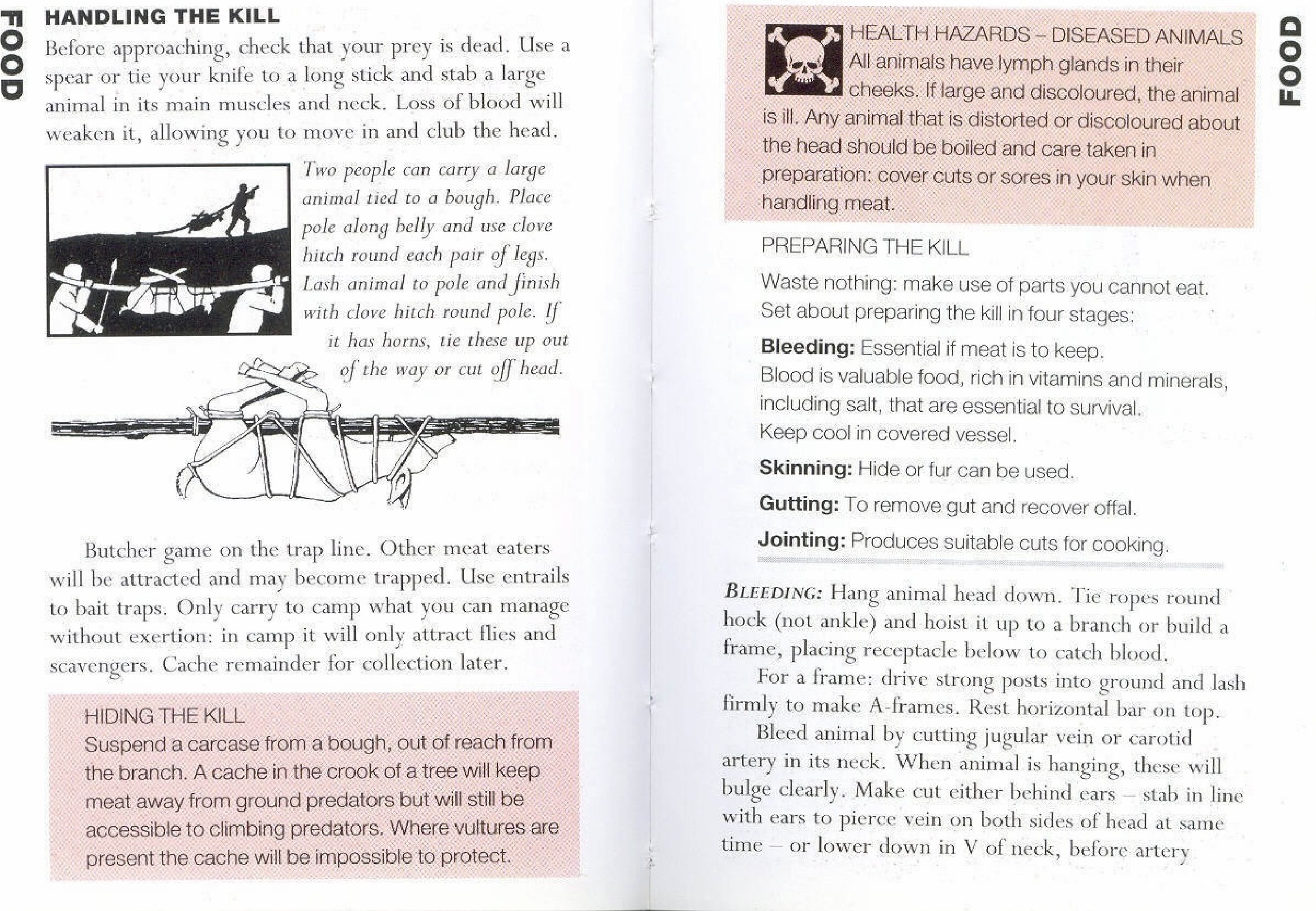
SAS 064 – Handling the Kill
Related posts:
SAS 009 - Water
Most essential thing during a fire disaster is Water. To find enough water, one can keep the mouth of the bag at the top with ta corner hanging low to collect water. Suspend tent from the apes or support with padded stick.
Most essential thing during a fire disaster is Water. To find enough water, one can keep the mouth of the bag at the top with ta corner hanging low to collect water. Suspend tent from the apes or support with padded stick.
SAS 175 - Disaster Strategy & Fire
Escaping through fire: Sometimes the best escape route may be to run through the flames. This is impossible if they are very intense and the area covered by thefire is great. In a large clearing or on heath land, however, it may be possible to run through less dense fire to refuge on the already burned-out land.
Escaping through fire: Sometimes the best escape route may be to run through the flames. This is impossible if they are very intense and the area covered by thefire is great. In a large clearing or on heath land, however, it may be possible to run through less dense fire to refuge on the already burned-out land.
SAS 173 - Disaster Strategy & Fire
The best protection from fire is prevention. many fires are caused by carelessness with lighted cigarettes and burning matches. The sun shining through a piece of glass can start a blaze in a dry season. If you are present where a fire starts in woodland, or on heath or grassland, your first action should be to smother it.
The best protection from fire is prevention. many fires are caused by carelessness with lighted cigarettes and burning matches. The sun shining through a piece of glass can start a blaze in a dry season. If you are present where a fire starts in woodland, or on heath or grassland, your first action should be to smother it.
SAS 084 - Fire
Gouge a small depression at a near end of baseboard. Cut a cavity below for tiner. Shape the spindle evenly. Make a bow from a pliable shoot and hide, twine or a bootlace. Use hollow piece of stone wood to steady top of the spindle and exert downloard pressure. Wind bowstring once round spindle.
Gouge a small depression at a near end of baseboard. Cut a cavity below for tiner. Shape the spindle evenly. Make a bow from a pliable shoot and hide, twine or a bootlace. Use hollow piece of stone wood to steady top of the spindle and exert downloard pressure. Wind bowstring once round spindle.
PS Family Supply Kit (1)
Disasters happen anytime and any where. And when disaster strikes, you may not have much time to respond. A highway spill of hazardous material could mean instant evacuation. After a disaster, local officials and relief workers will be on the scene, but they cannot reach everyone immediately.
Disasters happen anytime and any where. And when disaster strikes, you may not have much time to respond. A highway spill of hazardous material could mean instant evacuation. After a disaster, local officials and relief workers will be on the scene, but they cannot reach everyone immediately.
SAS 105 - Knots
There techniques for lashing differ consistent with the position of the segments. THese strategies are significant in making flatboats, safe houses and so on.
There techniques for lashing differ consistent with the position of the segments. THese strategies are significant in making flatboats, safe houses and so on.
SAS 005 - Survival Kits & Knives
Items like Messtin, Pencil-Sized Torch, Marker Panel, Matches, Brew Kit, Food, Survival Bag makes a survival kit complete. Ideally all these items are mandatory to be on a safer side when a disaster takes place.
Items like Messtin, Pencil-Sized Torch, Marker Panel, Matches, Brew Kit, Food, Survival Bag makes a survival kit complete. Ideally all these items are mandatory to be on a safer side when a disaster takes place.
SAS 044 - Tropical Plants
Always do not pick more than you need the edible plants. Food deteriorates rapidly in the tropics. Edible plants like Bignay, Mango, Sweet sop, Sour sop, Wild Fig, Ceylon Spinach, Tamarind Peanut and the Yam Beans are the most powerful edible plants.
Always do not pick more than you need the edible plants. Food deteriorates rapidly in the tropics. Edible plants like Bignay, Mango, Sweet sop, Sour sop, Wild Fig, Ceylon Spinach, Tamarind Peanut and the Yam Beans are the most powerful edible plants.
SAS 156 - Diseases
To reduce risk keep skin covered, sleep under a mosquito net, use insect repellents, and do not camp near swamps or stagnat water. A course of tablets, begun before exposure, can protect against malaria. Not restricted to the tropics, transmitted through saliva of female anpheles mosquito. It kills over a million people a year in Africa alone.
To reduce risk keep skin covered, sleep under a mosquito net, use insect repellents, and do not camp near swamps or stagnat water. A course of tablets, begun before exposure, can protect against malaria. Not restricted to the tropics, transmitted through saliva of female anpheles mosquito. It kills over a million people a year in Africa alone.
SAS 157 - Diseases
Some of the cold climate hazards are Hypothermia. Loss of temperature due to exposure, brought on by exhaustion, inadequate clothing or shelter, lack of food, lack of knowledge and preperation. Wet clothing or immersion in cold water will aggravate it, as will anxiety, stress and injuries that immobilise.
Some of the cold climate hazards are Hypothermia. Loss of temperature due to exposure, brought on by exhaustion, inadequate clothing or shelter, lack of food, lack of knowledge and preperation. Wet clothing or immersion in cold water will aggravate it, as will anxiety, stress and injuries that immobilise.
PS Family Supply Kit (2)
The image in the post shows the six basics that one should stock in the home before even a disaster takes place. They should stock water, food, first aid supplies, clothing and bedding.
The image in the post shows the six basics that one should stock in the home before even a disaster takes place. They should stock water, food, first aid supplies, clothing and bedding.
SAS 030 - Edible Plants
In Spring and summer yound shoots are tender. Some may be eaten raw; many are best cooked; wash in clean water, rub off hairs and boil in a little water so they cook in the steam. Leaves are rich in vitamins and minerals.
In Spring and summer yound shoots are tender. Some may be eaten raw; many are best cooked; wash in clean water, rub off hairs and boil in a little water so they cook in the steam. Leaves are rich in vitamins and minerals.
Surviving Hostage Situation
Who needs to hold up till they catch Hands Up ! To resolve how to survive a prisoner scenario ? Straight Bolz, who independently arranged the discharge of more than 800 prisoners as head of New York Police Dept prisoner arrangement group, discloses the 12 steps to getting out in one piece.
Who needs to hold up till they catch Hands Up ! To resolve how to survive a prisoner scenario ? Straight Bolz, who independently arranged the discharge of more than 800 prisoners as head of New York Police Dept prisoner arrangement group, discloses the 12 steps to getting out in one piece.
SAS 168 - Poisonous Snakes & Lizards
Crocodiles and alligators are amphibious, livingo n the banks of lakes, streams and swamps. Not all species are considered dangerous, but do not take chances. Most float almost submerged with only eyes and nostrils breaking the surface of the water.
Crocodiles and alligators are amphibious, livingo n the banks of lakes, streams and swamps. Not all species are considered dangerous, but do not take chances. Most float almost submerged with only eyes and nostrils breaking the surface of the water.
SAS 112 - Direction Finding & Weather
Weather is much more localised than climate and there can be marked variations between one small area and the next. A regular pattern of day-night change in wind direction suggests a large body of water - whether an ocean, inland sea or a lake - in the direction from which the day wind blows.
Weather is much more localised than climate and there can be marked variations between one small area and the next. A regular pattern of day-night change in wind direction suggests a large body of water - whether an ocean, inland sea or a lake - in the direction from which the day wind blows.
PS Family Disaster Plan (2)
To be on a safer side, keep enough supplies in your home to help for no less than several days. Amass a fiasco Supplies unit with things you might need in a clearing. Store the aforementioned supplies in inquiry, effortless to convey holders for instance rucksacks, duffel packs or secured waste compartments.
To be on a safer side, keep enough supplies in your home to help for no less than several days. Amass a fiasco Supplies unit with things you might need in a clearing. Store the aforementioned supplies in inquiry, effortless to convey holders for instance rucksacks, duffel packs or secured waste compartments.
PS Family Supply Kit (3)
Store your kit in a convenient place known to all family members. Keep a smaller verstion of the Disaster Supplies Kit in the trunk of your car. keep items in air tight plastic bags. Change your stored water supply every six months so it stays fresh.
Store your kit in a convenient place known to all family members. Keep a smaller verstion of the Disaster Supplies Kit in the trunk of your car. keep items in air tight plastic bags. Change your stored water supply every six months so it stays fresh.
SAS 031 - Edible Plants
Some plants have edible stems. If they are soft, peel off outer stringy parts, slice, then boil. Inner pith of some stems, example elder, can be extracted by splitting stem and eaten. Use fibrous stems to make twine.
Some plants have edible stems. If they are soft, peel off outer stringy parts, slice, then boil. Inner pith of some stems, example elder, can be extracted by splitting stem and eaten. Use fibrous stems to make twine.
 Upload your infographic here and contribute to our community.
Leave a Reply