
Image shows some of the plants which may be of use, but lacking accurate data on medicinal plants you will do better to take medicineswith you. Never experiment with plants you cannot positively identify.
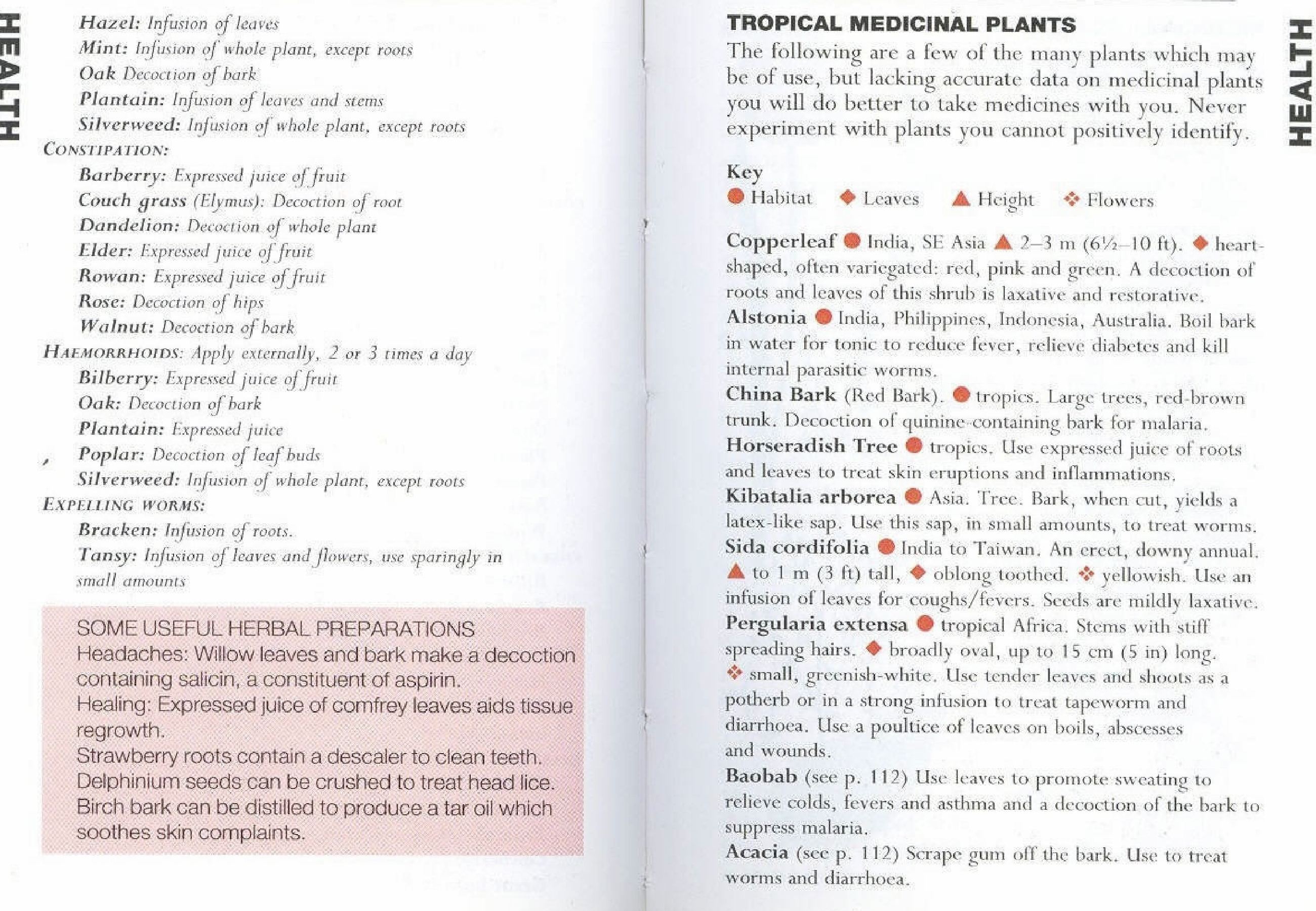
SAS 160 – Natural Medicine
Related posts:
SAS 173 - Disaster Strategy & Fire
The best protection from fire is prevention. many fires are caused by carelessness with lighted cigarettes and burning matches. The sun shining through a piece of glass can start a blaze in a dry season. If you are present where a fire starts in woodland, or on heath or grassland, your first action should be to smother it.
The best protection from fire is prevention. many fires are caused by carelessness with lighted cigarettes and burning matches. The sun shining through a piece of glass can start a blaze in a dry season. If you are present where a fire starts in woodland, or on heath or grassland, your first action should be to smother it.
SAS 043 - Desert & Tropical Plants
Growing tip, enclosed by crown of leaves or bases of leaf stems, is edible in most palms - eat if not too bitter. Avoid fruit unless positively identified.
Growing tip, enclosed by crown of leaves or bases of leaf stems, is edible in most palms - eat if not too bitter. Avoid fruit unless positively identified.
SAS 027 - Food Values
A healthy body can survive on reserves stored in its tissues, but food is needed to supply heat and energy, and to recover after hard work, injury or sickness. Seventy calories per hour are required just for breathing and basic bodily functions.
A healthy body can survive on reserves stored in its tissues, but food is needed to supply heat and energy, and to recover after hard work, injury or sickness. Seventy calories per hour are required just for breathing and basic bodily functions.
SAS 126 - Sea Survival & Water Rationing
During the survival at the sea, pyrotechnic equipment must be kept secure and dry. Read carefully the instruction and beware of fire hazards. When firingflares do not point them downwards or towards yourself or anyone else. Use flares only when certain they will be seen. Fire when a plane is flying towards you, not when it has gone past.
During the survival at the sea, pyrotechnic equipment must be kept secure and dry. Read carefully the instruction and beware of fire hazards. When firingflares do not point them downwards or towards yourself or anyone else. Use flares only when certain they will be seen. Fire when a plane is flying towards you, not when it has gone past.
Nerve Points
The High Section of the Nerve points consists of the Jaw, the Front of Shoulder Muscle and the middle section contains the Biceps the Forearm Muscle and the Back of the hands. The image pictorially explains the Nerve points.
The High Section of the Nerve points consists of the Jaw, the Front of Shoulder Muscle and the middle section contains the Biceps the Forearm Muscle and the Back of the hands. The image pictorially explains the Nerve points.
PS Family Disaster Plan (4)
If disaster strikes, Remain calm and Patient. Put your plan into Action.Check for injuries and give first aid and get help for seiously injured people.Listen to your battery powered radio for news and instructions. Evacuate, if advised to do so. Wear protective clothing and sturdy shoes.
If disaster strikes, Remain calm and Patient. Put your plan into Action.Check for injuries and give first aid and get help for seiously injured people.Listen to your battery powered radio for news and instructions. Evacuate, if advised to do so. Wear protective clothing and sturdy shoes.
SAS 141 - First Aid & Choking
Holger Nielson Method of Respiration: Use to resuscitate a drowning victim if mouth to mouth not possible. Face-down position allows liquids to flow freely from mouth without choking the patient. Lay victim face-down, head turned to one side, arms bent, forehead resting on hands. Loosen tight garments, clear mouth of weed, mud etc and ensure tongue is brought forward.
Holger Nielson Method of Respiration: Use to resuscitate a drowning victim if mouth to mouth not possible. Face-down position allows liquids to flow freely from mouth without choking the patient. Lay victim face-down, head turned to one side, arms bent, forehead resting on hands. Loosen tight garments, clear mouth of weed, mud etc and ensure tongue is brought forward.
SAS 178 - Disaster Strategy, Flood, Tsunami & Avalanche
A tsunami or tidal wave is linked with an earthquake beneath the ocean, creating a series of waves which can reach more than 30m. Not all earthquakes cause tsunami, but any earthquake could.
A tsunami or tidal wave is linked with an earthquake beneath the ocean, creating a series of waves which can reach more than 30m. Not all earthquakes cause tsunami, but any earthquake could.
Healing Bullet Wounds
Stop the bleeding by applying pressure directly to the wound with any available clean cloth. If the bullet has exited the body, apply pressure to both puncture areas. Remove the bullet, if it's still inside the body, with a pair of sterlized hemostats, Most of the bullet fragment upon impact to ensure that all bullet fragments are removed.
Stop the bleeding by applying pressure directly to the wound with any available clean cloth. If the bullet has exited the body, apply pressure to both puncture areas. Remove the bullet, if it's still inside the body, with a pair of sterlized hemostats, Most of the bullet fragment upon impact to ensure that all bullet fragments are removed.
Fire Protection
Fire protection is the investigation and polish of alleviating the unwanted impacts of reasonably ruinous fires. It includes the investigation of the conduct, compartmentalisation, suppression and examination of fiery breakout and it is identified crises, and the exploration and improvement, generation, testing and provision of relieving frameworks. In structures, be they land-based, offshore or e...
Fire protection is the investigation and polish of alleviating the unwanted impacts of reasonably ruinous fires. It includes the investigation of the conduct, compartmentalisation, suppression and examination of fiery breakout and it is identified crises, and the exploration and improvement, generation, testing and provision of relieving frameworks. In structures, be they land-based, offshore or e...
051 Animal Tracking
Squirrels and Prairie dogs Occur everywhere except Australasia and the Poles, hibernating in COld areas. With wallables and other relatives, limited to Australia, Large kinds can strike a powerful blow with hind feet. Most active at night. Opossums are Small nocturnal scavengers of S.America and USA. Crocodiles and Alligators are found in most subtropical and tropical areas. Avoid Large ones. Li...
Squirrels and Prairie dogs Occur everywhere except Australasia and the Poles, hibernating in COld areas. With wallables and other relatives, limited to Australia, Large kinds can strike a powerful blow with hind feet. Most active at night. Opossums are Small nocturnal scavengers of S.America and USA. Crocodiles and Alligators are found in most subtropical and tropical areas. Avoid Large ones. Li...
Fallout Shelter (1)
A fallout shelter is an encased space extraordinarily composed to secure tenants from radioactive flotsam and jetsam or aftermath coming about because of an atomic eruption. Numerous such havens were built as civil barrier measures around the Freezing War.
A fallout shelter is an encased space extraordinarily composed to secure tenants from radioactive flotsam and jetsam or aftermath coming about because of an atomic eruption. Numerous such havens were built as civil barrier measures around the Freezing War.
SAS 119 - Moving on Waterways
A wide river will be easier to float on than to walk beside. Long-term survivors should experiment with making canoes by burning out the centre of a tree trunk or covering a frame of willow with birch bark or skins.
A wide river will be easier to float on than to walk beside. Long-term survivors should experiment with making canoes by burning out the centre of a tree trunk or covering a frame of willow with birch bark or skins.
Neck Punch
A strong tip is to punch them on the Neck when they aren't looking at you.
A strong tip is to punch them on the Neck when they aren't looking at you.
SAS 013 - Climate & Terrain
Survival can also be obtained from the Decidous Forests, The Temperate Grasslands, Mediterranean regions, Tropical Forests, Savannahs. Be guided by the constellations and travel by night without depending much on the compasses as they are very unreliable.
Survival can also be obtained from the Decidous Forests, The Temperate Grasslands, Mediterranean regions, Tropical Forests, Savannahs. Be guided by the constellations and travel by night without depending much on the compasses as they are very unreliable.
SAS 036 - Edible Plants
Some poisonous plants are easy to mistake for edible species. Do not take risks: identify carefully. Learn to recognise the following in addition to those illustrated: The ButterCups, Lupins, Vetches or Locoweeds, False Helleborines, Henbane, Virginia Creeper, BUckthorns.
Some poisonous plants are easy to mistake for edible species. Do not take risks: identify carefully. Learn to recognise the following in addition to those illustrated: The ButterCups, Lupins, Vetches or Locoweeds, False Helleborines, Henbane, Virginia Creeper, BUckthorns.
SAS 003 - Survival Kit
Make sure you prepare a checklist that contains Equipments for Clothes, Sleeping Bags, Backpack, Stowing Kit, Radio kit and everything pertaining to Vehicles.
Make sure you prepare a checklist that contains Equipments for Clothes, Sleeping Bags, Backpack, Stowing Kit, Radio kit and everything pertaining to Vehicles.
SAS 080 - Building Shelter & Fire
Fire is crucial to survival. It furnishes warmth, security and a method of signalling; it bubbles water, cooks and jam nourishment; it warms metal to make instruments and prepare pots. You should memorize to light a blaze at whatever place under any conditions. It is not enough to know every last trace of the techniques – you need to be master at them.
Fire is crucial to survival. It furnishes warmth, security and a method of signalling; it bubbles water, cooks and jam nourishment; it warms metal to make instruments and prepare pots. You should memorize to light a blaze at whatever place under any conditions. It is not enough to know every last trace of the techniques – you need to be master at them.
 Upload your infographic here and contribute to our community.
Leave a Reply