
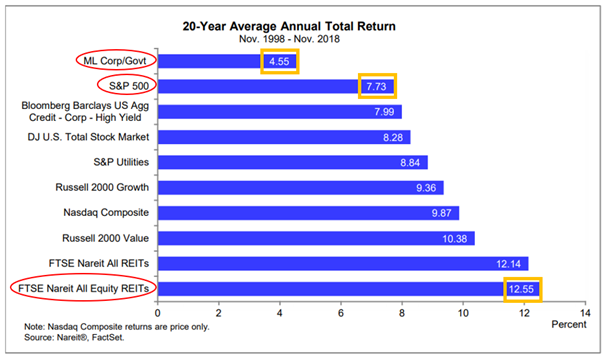
Not all markets are created equal. At least, according to this newest infographic. According to FactSet, over a 20 year average annual total return, which would include capital gains and dividends, REITs or Real Estate Investment Trusts have returned more than the S&P 500.
And this gain over the S&P 500 is pretty significant: 4.82% higher gain than the S&P 500. Even more interesting, the S&P Utilities index also yielded more than the S&P 500 by over 1%! That seems to be counter intuitive that a lower risk based asset yields more than an index, but in a lower interest rate environment, REITs, Utilities, and higher dividend players can have an advantage. With lower interest rates, companies can invest in longer term fixed assets and gain a better spread, as the rate these earning assets help produce is not affected as much.
So next time you think a utility company or a REIT is boring, check out the graph below!
Related posts:
While 2009 began on depressing note, the economy showed signs of resurgence towards the end of the year. Crude oil prices shoot up in tight of increasing demands. Economic growth has shown a marked rise. Domestic mutal fund investments become increasingly volatile. Foreign institutional investors begin on a wary note turn positive. Industrial production moves up.Export growth was flat, but im...
Banking on the world bank shows that each countries around the world are depending on its assistance to help them support their often fragile economies.
Initial public offerings, a measure of china's financial strength, hong kong and shanghai are now global leaders supplanting new york. by virtues of this holdings, china has become america's biggest foreign lender. no country has ever loaned another so much money.Nor has any held so much reserves.
Workflow map keeps you in control, relaxed, focuses and inspired.
Ways kids use money by age rage should be at the age 10, 10-14 and 15-18. One of the major influencer for children younger than 10 is their own piggy bank.Three times as many children under 10 have bank accounts than their parents did when they were that age.Every kids should learn how to save money for them selves.So that they would know the value of it.
The S&P 500 index is a stock market index which tracks the top 500 public companies by market cap. This is generally considered a good indicator of the health of the United States economy since other indexes such as the DOW and Nasdaq have either too few equities in the index or are weighted too heavily toward technology respectively. The below infographic shows each time a news contribu...
What beyond car insurance? Weird insurances, this is a policy normaly cost $150 per $1.5 million in coverage as of 1998 it is called alien abduction. $125 for celebration interruptus. This is for cancellation or postponement coverage.50$ cork fly in the cellar.In Ransom reimbursement, high profile people would pay about $2500 to $10,000. For rained out, $404 and for Disability coverae for stallion...
Find out about why the Jaguar F-Pace is the fastest selling Jaguar ever. From its understated luxury, to its impressive driving performance and latest technology, the F-Pace has been a hit with buyers, having beaten out sales of the likes of the Range Rover Sport.
Just where did all the money goes? Easy credit, no cash no porblem. Debt turns toxic take out a loan on a house, this is one of the most basic tools of finance.
Online product ideas start from your knowledge, your interests and passion. Solving problem with pet peeve, vanity, physical, emotional, financial, chore and product failure. Enable giving by sharing congratulations, expressing sympathy and show love and friendship. Design your own playground by creating games, time-wasters and quizzes/memes.Let them manage and accesorize it by skins and cases and...
The lending of payday loans or paycheck advance loans has been deemed to be loan sharing in 13 states.So if you have ever been in the previous situation, your credit rating is probably pretty bad. Not all credit cards are created equal. When seeking the convenience of plastic, know what you are signing up for.Some stuff isnt cheap, and it can be hard to pay upfront for high cost ietm if credit is ...
 Upload your infographic here and contribute to our community.
Leave a Reply