
Rabbits are widespread and easy to catch. Most live in burrows, often in large numbers and using well worn runs – the places to set snares. Hares do not live in burrows and tend not to have regular runs.
It is not possible to survive on rabbit alone, no matter how many you eat. The body needs minerals and vitamins which rabbit does not provide, make sure to balance your diet with vegetation.
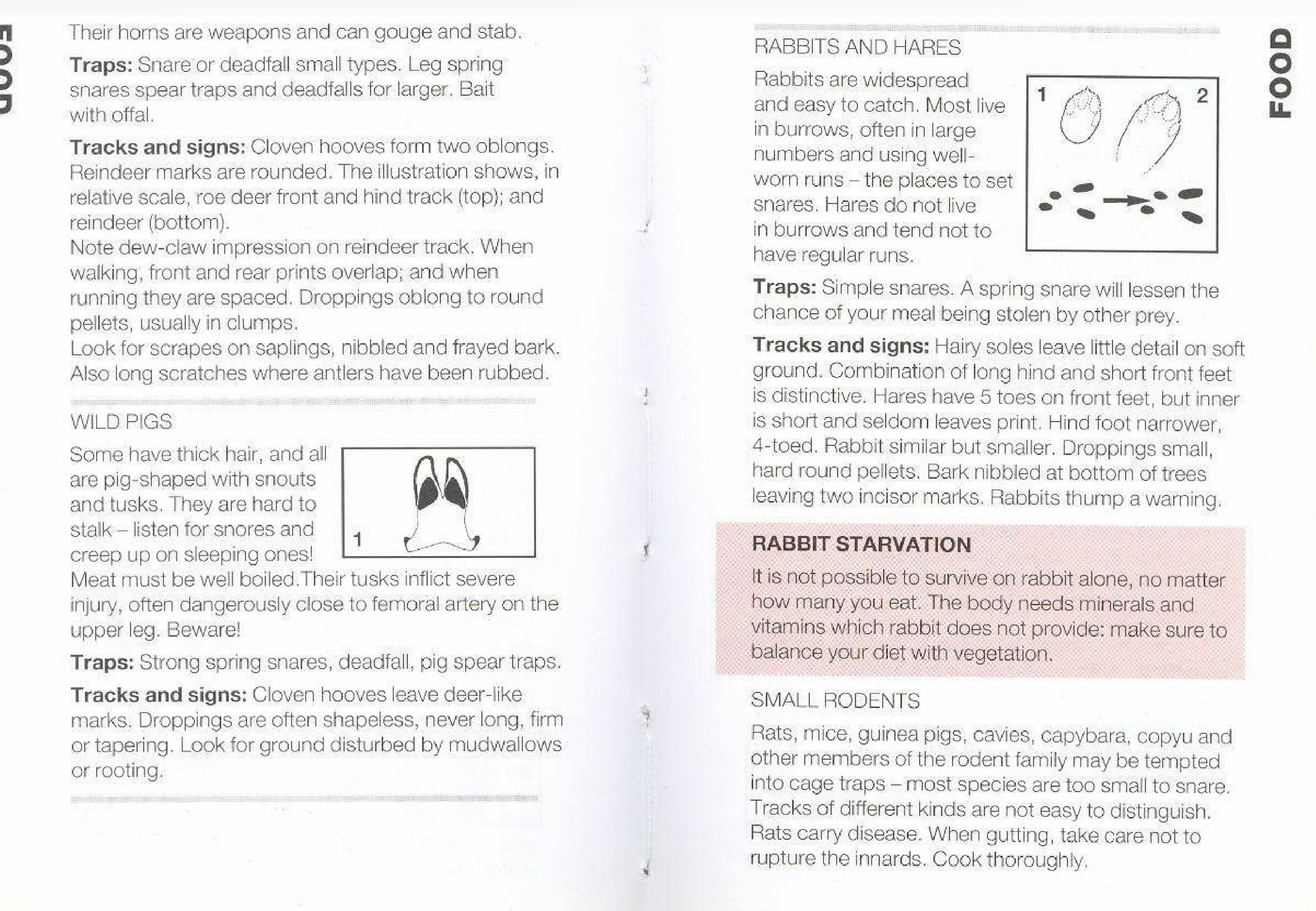
SAS 050 – Animal Tracking
Related posts:
SAS 076 - Building Shelter
In rain forests and jungle where the ground is damp and crawling with insects a raised bed is preferable. Unless the nigths are cold, the number one priority will be to keep rasonably dry.
In rain forests and jungle where the ground is damp and crawling with insects a raised bed is preferable. Unless the nigths are cold, the number one priority will be to keep rasonably dry.
SAS 113 - Reading Weather with Clouds
Clouds are the most reliable of weather signs. There are ten main types of cloud formation. Approximate altitudes are given for each type. THe same shapes occur at lower altitutudes in polar regions.
Clouds are the most reliable of weather signs. There are ten main types of cloud formation. Approximate altitudes are given for each type. THe same shapes occur at lower altitutudes in polar regions.
SAS 120 - Moving on Waterways
Moving on the waterways needs to be done very carefully. A large group will need several rafts. The first should carry no equipment or provisions, just the fittest group members to act as lookouts and warn of hazards. Waterfalls and rapids are often indicated by spray or mist. They can also be heard for some distance. If in doubt, moor the raft and reconnoitre on foot.
Moving on the waterways needs to be done very carefully. A large group will need several rafts. The first should carry no equipment or provisions, just the fittest group members to act as lookouts and warn of hazards. Waterfalls and rapids are often indicated by spray or mist. They can also be heard for some distance. If in doubt, moor the raft and reconnoitre on foot.
SAS 145 - First Aid & Wounds
Soap is an antiseptic: use to wash wounds. Wash hands in boiled water before cleaning wound. Wash wound in boiled water or if none is available use urine, which is sterile and will not introduce infection.
Soap is an antiseptic: use to wash wounds. Wash hands in boiled water before cleaning wound. Wash wound in boiled water or if none is available use urine, which is sterile and will not introduce infection.
SAS 058 - Animal Trapping
A deadfall is an ample shake or log that is tilted on a plot and kept up with areas of limbs (stays), with one of them that serves as a trigger. When the creature moves the trigger which may have trap on or close it, the rock or log falls, pounding the creature. The figure-four dead fall is an in vogue and basic trap built from materials recognized in the hedge.
A deadfall is an ample shake or log that is tilted on a plot and kept up with areas of limbs (stays), with one of them that serves as a trigger. When the creature moves the trigger which may have trap on or close it, the rock or log falls, pounding the creature. The figure-four dead fall is an in vogue and basic trap built from materials recognized in the hedge.
SAS 129 - Sea Survival, Rescue & Signalling
Making a Land Fall: When approaching land, select a landing point where it will be easy to beach or swim ashore. Take down the sail; the sea anchor will keep you pointing at the shore and will slow down your progress. Steer away from rocks.
Making a Land Fall: When approaching land, select a landing point where it will be easy to beach or swim ashore. Take down the sail; the sea anchor will keep you pointing at the shore and will slow down your progress. Steer away from rocks.
SAS 185 - Disaster Strategy & Vehicles
Clutch SlipL Often brought about by oil or oil getting on the clutch plates. To degrease, utilize the blaze quencher, squirt it through review plate opening.
Clutch SlipL Often brought about by oil or oil getting on the clutch plates. To degrease, utilize the blaze quencher, squirt it through review plate opening.
SAS 011 - Water
Water can also be obtained from animal eyes which can be extracted by sucking them.All fish contain a drinkable fluid. Large fish, in particular, have a reservoir of fresh water along the spine. Tap it by gutting the fish and, keeping the fish flat, remove the backbone, being careful not to spill the liquid, and then drink it.
Water can also be obtained from animal eyes which can be extracted by sucking them.All fish contain a drinkable fluid. Large fish, in particular, have a reservoir of fresh water along the spine. Tap it by gutting the fish and, keeping the fish flat, remove the backbone, being careful not to spill the liquid, and then drink it.
SAS 085 - Fire
Firelighting with Chemicals: The mixture containing Potassium Chlorate and sugar, Potassium permanganate and sugar and sodum chlorate and sugar are the perfect mixtures for the Camp Craft.
Firelighting with Chemicals: The mixture containing Potassium Chlorate and sugar, Potassium permanganate and sugar and sodum chlorate and sugar are the perfect mixtures for the Camp Craft.
SAS 107 - Knots & Map Reading
Notwithstanding having the capacity to peruse and make a guide, your survival hinges on translating indigenous marks to help you discover your direction and to suspect the climate.
Notwithstanding having the capacity to peruse and make a guide, your survival hinges on translating indigenous marks to help you discover your direction and to suspect the climate.
SAS 037 - Edible Plants
Not all parts of the trees are edible. The outer bark is inedible, but the thin inner bark of certain trees can be eaten in Spring, when sap has started to flow. Peel back bark near bottom of tree or form exposed roots to reveal inner layer. Can be eaten raw, but boiling will reduce to gelatinous mass which can be roasted and ground for use as flour. Some of the poisonous trees contain irritant ...
Not all parts of the trees are edible. The outer bark is inedible, but the thin inner bark of certain trees can be eaten in Spring, when sap has started to flow. Peel back bark near bottom of tree or form exposed roots to reveal inner layer. Can be eaten raw, but boiling will reduce to gelatinous mass which can be roasted and ground for use as flour. Some of the poisonous trees contain irritant ...
SAS 181 - Disaster Strategy, Lightning & Earthquake
Stay Low: You can sometimes sense that a lightning strike is imminent by a tingling in the skin and the sensation of the hair standing up on end. If you are standing up, drop to the ground at once, going first to the knees with the hands touching the ground.
Stay Low: You can sometimes sense that a lightning strike is imminent by a tingling in the skin and the sensation of the hair standing up on end. If you are standing up, drop to the ground at once, going first to the knees with the hands touching the ground.
PS Family Disaster Plan (6)
Learn the types of natural disasters in your region. Local Emergency management or civil denense officials can identify which disasters are most liekly to hit your community.Identify which human-caused or technological disasters can affect your region
Learn the types of natural disasters in your region. Local Emergency management or civil denense officials can identify which disasters are most liekly to hit your community.Identify which human-caused or technological disasters can affect your region
SAS 019 - Terrain Dangers
Some of the areas of danger on the terrains are the avalanches. They are a serious hazard in all high mountian regions. Most seashores offer abundant sources of food and excellent prospects for survival.
Some of the areas of danger on the terrains are the avalanches. They are a serious hazard in all high mountian regions. Most seashores offer abundant sources of food and excellent prospects for survival.
PS Family Disaster Plan (3)
Going with neighbours can recovery exists and property. Meet with your neighbours to idea how the neighborhood might work as a single unit after a calamity until assistance arrives. Depending on if you are a part of a neighbourhood conglomeration, for example a home cooperation or wrongdoing watch aggregation, present catastrophe preparedness as another movement....
Going with neighbours can recovery exists and property. Meet with your neighbours to idea how the neighborhood might work as a single unit after a calamity until assistance arrives. Depending on if you are a part of a neighbourhood conglomeration, for example a home cooperation or wrongdoing watch aggregation, present catastrophe preparedness as another movement....
SAS 070 - Fishing
Huge fish might be gotten in a noose line settled to the finish of a post, or passed down within a length of bamboo. Pass circle over fish from tail close and force up sharply so that the noose traps fish.
Huge fish might be gotten in a noose line settled to the finish of a post, or passed down within a length of bamboo. Pass circle over fish from tail close and force up sharply so that the noose traps fish.
PS Emergency Preparedness Checklist (3)
Get ready amaze arrangements prepared that incorporates Normal Exit track, Emergency passageway tracks, Fire Extinguisher, Smoke Detectors, Disaster supplies assortment, Doors, Collapsible Ladder and all crisis things in the Floor arrangements.
Get ready amaze arrangements prepared that incorporates Normal Exit track, Emergency passageway tracks, Fire Extinguisher, Smoke Detectors, Disaster supplies assortment, Doors, Collapsible Ladder and all crisis things in the Floor arrangements.
SAS 171 - Dangerous Water Creatures
Porcupine fish, Puffer fish, TriggerFish are very poisonous to eat. They differ somewhat in appearance, but when alarmed all inflate into a spiny ball. The flesh of these animals is poisonous.
Porcupine fish, Puffer fish, TriggerFish are very poisonous to eat. They differ somewhat in appearance, but when alarmed all inflate into a spiny ball. The flesh of these animals is poisonous.
 Upload your infographic here and contribute to our community.
Leave a Reply