
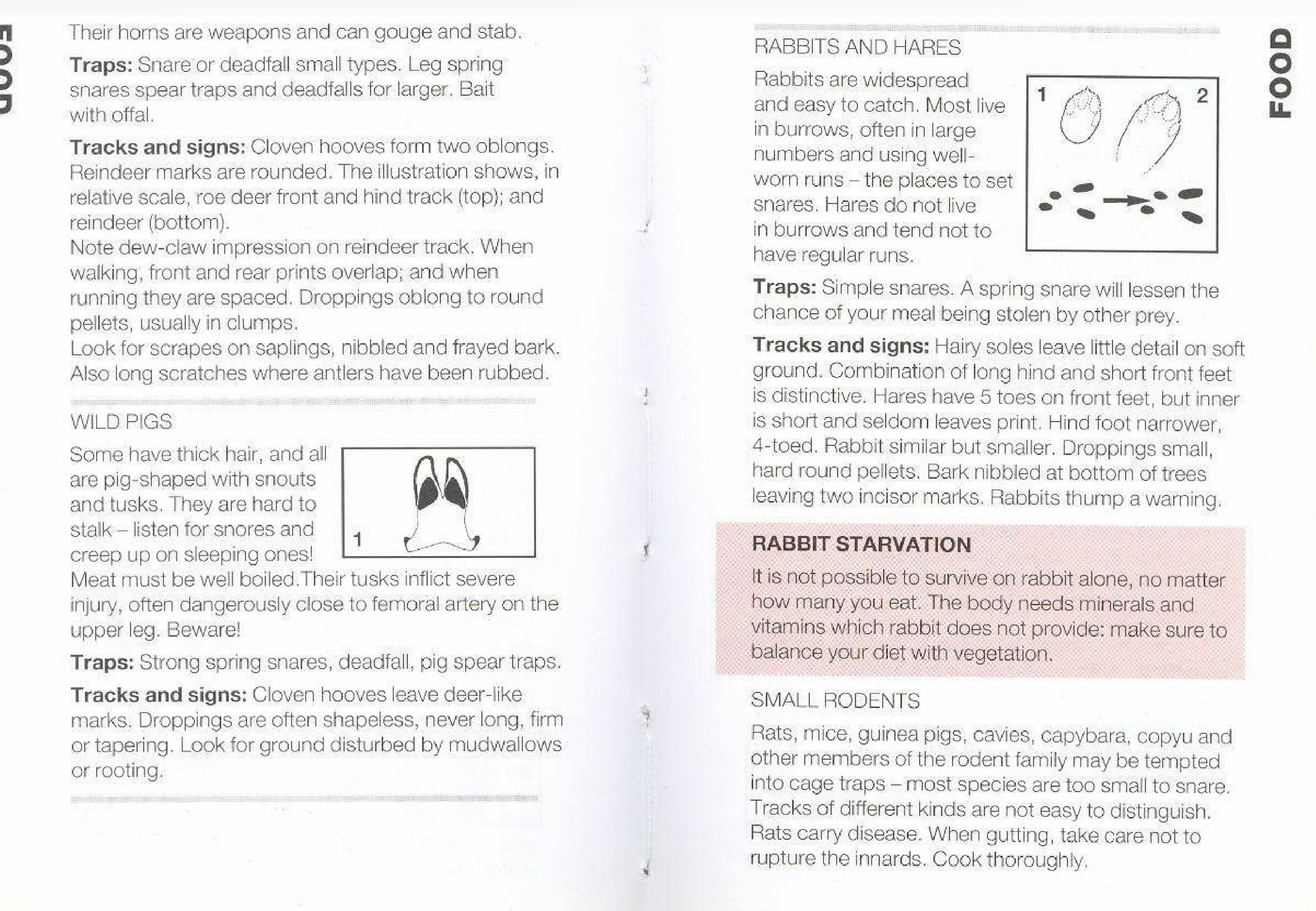
Rabbits are widespread and easy to catch. Most live in burrows, often in large numbers and using well worn runs – the places to set snares. Hares do not live in burrows and tend not to have regular runs.
It is not possible to survive on rabbit alone, no matter how many you eat. The body needs minerals and vitamins which rabbit does not provide, make sure to balance your diet with vegetation.
SAS 050 – Animal Tracking
Related posts:
PS Family Supply Kit (3)
Store your kit in a convenient place known to all family members. Keep a smaller verstion of the Disaster Supplies Kit in the trunk of your car. keep items in air tight plastic bags. Change your stored water supply every six months so it stays fresh.
Store your kit in a convenient place known to all family members. Keep a smaller verstion of the Disaster Supplies Kit in the trunk of your car. keep items in air tight plastic bags. Change your stored water supply every six months so it stays fresh.
SAS 125 - Sea Survival & Signalling
How to Signal at Sea ? Use flares, dye markers and movement of any kind to attract attention at sea. If you have no signalling equipment, wave clothing or tarpauliins and churn the water if it is still. At night or in fog use a whistle to maintain contact with other survivors.
How to Signal at Sea ? Use flares, dye markers and movement of any kind to attract attention at sea. If you have no signalling equipment, wave clothing or tarpauliins and churn the water if it is still. At night or in fog use a whistle to maintain contact with other survivors.
Water Filter
Following the pictorial instructions carefully would reveal how to make a good water filter.
Following the pictorial instructions carefully would reveal how to make a good water filter.
PS Family Disaster Plan (4)
If disaster strikes, Remain calm and Patient. Put your plan into Action.Check for injuries and give first aid and get help for seiously injured people.Listen to your battery powered radio for news and instructions. Evacuate, if advised to do so. Wear protective clothing and sturdy shoes.
If disaster strikes, Remain calm and Patient. Put your plan into Action.Check for injuries and give first aid and get help for seiously injured people.Listen to your battery powered radio for news and instructions. Evacuate, if advised to do so. Wear protective clothing and sturdy shoes.
SAS 015 - Fire, Water & Food
Fuel origins are confined: driftwood, seal and flying creature large, fuel from wreckage – in compelling freezing empty oil from sump before it solidifies. Could be utilized strong if emptied on ground. In summer, water is abundant. Lake water may look tan and taste saline but vegetation developing in it keeps it natural.
Fuel origins are confined: driftwood, seal and flying creature large, fuel from wreckage – in compelling freezing empty oil from sump before it solidifies. Could be utilized strong if emptied on ground. In summer, water is abundant. Lake water may look tan and taste saline but vegetation developing in it keeps it natural.
SAS 063 - Hunting
The danger of hunting is animals will attack except in self-defence, but do not camp on a trail or near an animal watering spot. Do not provoke a bear encounter as bears are scavangers and will come to camps in search of food. Do not get close or try to catch them.
The danger of hunting is animals will attack except in self-defence, but do not camp on a trail or near an animal watering spot. Do not provoke a bear encounter as bears are scavangers and will come to camps in search of food. Do not get close or try to catch them.
SAS 052 - Animal Tracking
Trapping needs time but might be truly proficient. Trapping may be sheltered and cheap for the trapper, in any case in present day times it has come to be dubious, due to it is claimed cold-bloodedness. To some extent to location the aforementioned concerns, in 1996, the Association of Fish and Wildlife Agencies, a conglomeration made up of state and elected fish and untamed life channel experts, ...
Trapping needs time but might be truly proficient. Trapping may be sheltered and cheap for the trapper, in any case in present day times it has come to be dubious, due to it is claimed cold-bloodedness. To some extent to location the aforementioned concerns, in 1996, the Association of Fish and Wildlife Agencies, a conglomeration made up of state and elected fish and untamed life channel experts, ...
Surveillance & Privacy
Surveillance and privacy chart depicts the various rankins of protections and Surveillances that are made in different countries.
Surveillance and privacy chart depicts the various rankins of protections and Surveillances that are made in different countries.
SAS 181 - Disaster Strategy, Lightning & Earthquake
Stay Low: You can sometimes sense that a lightning strike is imminent by a tingling in the skin and the sensation of the hair standing up on end. If you are standing up, drop to the ground at once, going first to the knees with the hands touching the ground.
Stay Low: You can sometimes sense that a lightning strike is imminent by a tingling in the skin and the sensation of the hair standing up on end. If you are standing up, drop to the ground at once, going first to the knees with the hands touching the ground.
SAS 073 - Where to Camp & Building Shelter
You ought to be protected from the wind, close water but clear of any danger of flooding, with an ample supply of wood close nearby. Check above your head for dead wood in trees that might collision down in a heightened wind. don't camp opposite an amusement trail. Take notice that the intonation of running water can overwhelm different tumults which may show peril, or the intonation of quest...
You ought to be protected from the wind, close water but clear of any danger of flooding, with an ample supply of wood close nearby. Check above your head for dead wood in trees that might collision down in a heightened wind. don't camp opposite an amusement trail. Take notice that the intonation of running water can overwhelm different tumults which may show peril, or the intonation of quest...
Surviving a Thunderstorm
To survive from a thunderstorm, do not take cover under the tree's or any other wooden structure. If struck by lightning, they will effectively explode and you will be trapped under a fiery tree of death. On top of that, you will probably have quite a few big splinters.
To survive from a thunderstorm, do not take cover under the tree's or any other wooden structure. If struck by lightning, they will effectively explode and you will be trapped under a fiery tree of death. On top of that, you will probably have quite a few big splinters.
SAS 066 - Handling the Kill
Consume offal at the closest conceivable opportunity, anyway rest of meat is preferred hung to make it delicate and to execute parasites. In moderate temperatures, leave carcase hanging for 2-3 days. In smoking atmospheres, save or cook pronto.
Consume offal at the closest conceivable opportunity, anyway rest of meat is preferred hung to make it delicate and to execute parasites. In moderate temperatures, leave carcase hanging for 2-3 days. In smoking atmospheres, save or cook pronto.
SAS 123 - Sea Survival
Swim slowly and steadily. If abandoning a sinking boat or aircraft get upwind and stay clear of it. Keep away from any fuel slick. If forced to swim through flames, jump in feet first and up wind. Swim into the wind using breast stroke. Splash flames away from head to make breathing holes.
Swim slowly and steadily. If abandoning a sinking boat or aircraft get upwind and stay clear of it. Keep away from any fuel slick. If forced to swim through flames, jump in feet first and up wind. Swim into the wind using breast stroke. Splash flames away from head to make breathing holes.
Lock Pick B
Lock Pick bolt picks go with a "decoder" which lets the locksmith know at what profundities the pins broke the shear plane. By utilizing the interpreting key after the lock has been picked, the locksmith can reduce a tubular key to the right bind profundities and hence abstain from needing to swap the lock.
Lock Pick bolt picks go with a "decoder" which lets the locksmith know at what profundities the pins broke the shear plane. By utilizing the interpreting key after the lock has been picked, the locksmith can reduce a tubular key to the right bind profundities and hence abstain from needing to swap the lock.
SAS 058 - Animal Trapping
A deadfall is an ample shake or log that is tilted on a plot and kept up with areas of limbs (stays), with one of them that serves as a trigger. When the creature moves the trigger which may have trap on or close it, the rock or log falls, pounding the creature. The figure-four dead fall is an in vogue and basic trap built from materials recognized in the hedge.
A deadfall is an ample shake or log that is tilted on a plot and kept up with areas of limbs (stays), with one of them that serves as a trigger. When the creature moves the trigger which may have trap on or close it, the rock or log falls, pounding the creature. The figure-four dead fall is an in vogue and basic trap built from materials recognized in the hedge.
SAS 077 - Building Shelter
Atap and other large leaves when thatched make the best roofs and walls for jungle shelters. Look for any plant similarly structured, the bigger and broader the better. Closely layer halves of atap on a roof frame. Walls can be less dense.
Atap and other large leaves when thatched make the best roofs and walls for jungle shelters. Look for any plant similarly structured, the bigger and broader the better. Closely layer halves of atap on a roof frame. Walls can be less dense.
SAS 155 - Diseases
When in water, the survivor is more likely to be exposed to water - borne diseases, or those carried by insects and animals. Tropical diseases are less familiar and will therefore be dealt with here in more detail. Where drugs are not available, treatment is largely a matter of dealing with symptoms and making patient comfortable.
When in water, the survivor is more likely to be exposed to water - borne diseases, or those carried by insects and animals. Tropical diseases are less familiar and will therefore be dealt with here in more detail. Where drugs are not available, treatment is largely a matter of dealing with symptoms and making patient comfortable.
SAS 064 - Handling the Kill
During the hunting process, Waste Nothing, make use of parts you cannot eat. Set about preparing the kill in four stages that is: Bleeding, Skinning, Gutting and Jointing.
During the hunting process, Waste Nothing, make use of parts you cannot eat. Set about preparing the kill in four stages that is: Bleeding, Skinning, Gutting and Jointing.
 Upload your infographic here and contribute to our community.
Leave a Reply