
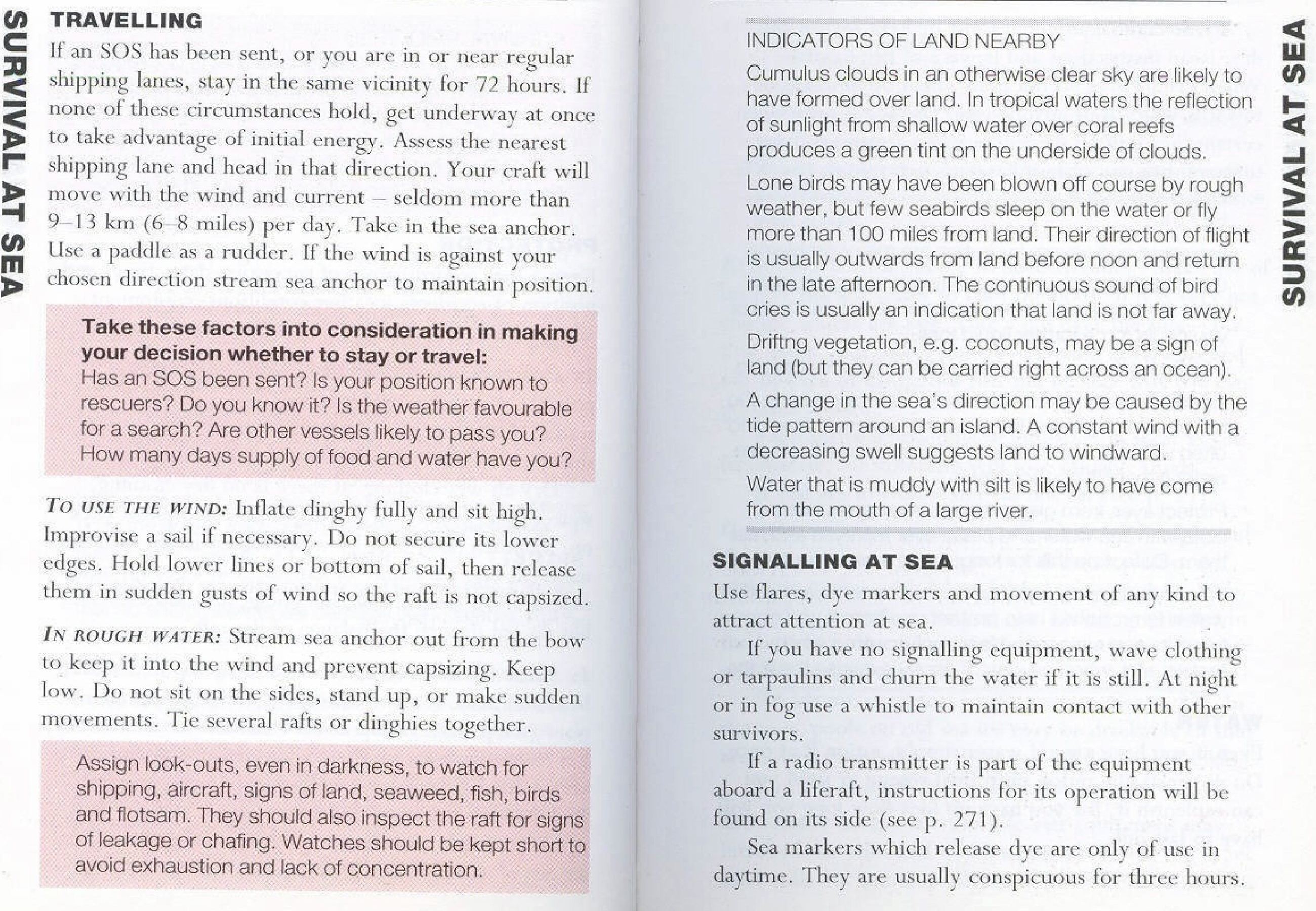
How to Signal at Sea ? Use flares, dye markers and movement of any kind to attract attention at sea. If you have no signalling equipment, wave clothing or tarpauliins and churn the water if it is still. At night or in fog use a whistle to maintain contact with other survivors.
SAS 125 – Sea Survival & Signalling
Related posts:
SAS 103 - Knots
SAS 063 - Hunting
The danger of hunting is animals will attack except in self-defence, but do not camp on a trail or near an animal watering spot. Do not provoke a bear encounter as bears are scavangers and will come to camps in search of food. Do not get close or try to catch them.
The danger of hunting is animals will attack except in self-defence, but do not camp on a trail or near an animal watering spot. Do not provoke a bear encounter as bears are scavangers and will come to camps in search of food. Do not get close or try to catch them.
SAS 093 - Camp Tools
Camp tools that are used in the camp craft are the Stone Tools, BOne tools, the axes.
Camp tools that are used in the camp craft are the Stone Tools, BOne tools, the axes.
SAS 033 - Edible Plants
Roots are starchiest between autumn and spring. All roots should be thoroughly cooked. Scrub in clean water, boil until soft, then roast on hot stones in embers. To cook more rapidly, cut into cubes. Use a sharpened stick to test if they are done.
Roots are starchiest between autumn and spring. All roots should be thoroughly cooked. Scrub in clean water, boil until soft, then roast on hot stones in embers. To cook more rapidly, cut into cubes. Use a sharpened stick to test if they are done.
SAS 053 - Animal Tracking
Small animals like termites, bees, wasps and hornets, Ants, Locusts, Crickets and grasshopers, snails slugs and worms can be easily tracked and trapped for hunting purposes.
Small animals like termites, bees, wasps and hornets, Ants, Locusts, Crickets and grasshopers, snails slugs and worms can be easily tracked and trapped for hunting purposes.
SAS 155 - Diseases
When in water, the survivor is more likely to be exposed to water - borne diseases, or those carried by insects and animals. Tropical diseases are less familiar and will therefore be dealt with here in more detail. Where drugs are not available, treatment is largely a matter of dealing with symptoms and making patient comfortable.
When in water, the survivor is more likely to be exposed to water - borne diseases, or those carried by insects and animals. Tropical diseases are less familiar and will therefore be dealt with here in more detail. Where drugs are not available, treatment is largely a matter of dealing with symptoms and making patient comfortable.
SAS 007 - Facing Disaster & Water
It is no use of giving up when a disaster takes place. Only positive action can save you. People can survive seemingly impossible situations if they have the determination. Self-confidence is a product of good training ad sound knowledge. These must be acquired before you face a survival situation .
It is no use of giving up when a disaster takes place. Only positive action can save you. People can survive seemingly impossible situations if they have the determination. Self-confidence is a product of good training ad sound knowledge. These must be acquired before you face a survival situation .
SAS 039 - Fungi
Agaricus organisms. Maintain a strategic distance from any that stain yellow when cut or wounded, or that scent of carbolic. Some green catches are difficult to recognize from the destructive amanitas.
Agaricus organisms. Maintain a strategic distance from any that stain yellow when cut or wounded, or that scent of carbolic. Some green catches are difficult to recognize from the destructive amanitas.
SAS 184 - Disaster Strategy & Vehicles
Transport has an important role to play in disaster strategy. Make sure you know how to get the best use out of your vehicle in any situation. If you are trapped in a blizzard, stay in the car. If you are on a regular traffic route you will probably soon be rescued. Going for help could be too risky.
Transport has an important role to play in disaster strategy. Make sure you know how to get the best use out of your vehicle in any situation. If you are trapped in a blizzard, stay in the car. If you are on a regular traffic route you will probably soon be rescued. Going for help could be too risky.
SAS 056 - Animal Trapping
A Paiute deadfall, comprising of several extended stays, in addition to a much more limited stay, plus a rope or strand material taken from the shrubbery to interconnect the much more limited stay (some of the time called get stay or trigger stay) with one of the longer stays, in addition to a rock or different large protest.
A Paiute deadfall, comprising of several extended stays, in addition to a much more limited stay, plus a rope or strand material taken from the shrubbery to interconnect the much more limited stay (some of the time called get stay or trigger stay) with one of the longer stays, in addition to a rock or different large protest.
SAS 062 - Hunting
A sling is a simple leather pouch in the middle of a length of thong or rope. Attach pouch as one piece threaded through, or two tied or sewn on. To Catapult, take a strong, pliable forked twig, and a piece of elastic material. Thread or swe a puch into the centre of the elastic, tie ends to each side of fork. Use a stones as missiles.
A sling is a simple leather pouch in the middle of a length of thong or rope. Attach pouch as one piece threaded through, or two tied or sewn on. To Catapult, take a strong, pliable forked twig, and a piece of elastic material. Thread or swe a puch into the centre of the elastic, tie ends to each side of fork. Use a stones as missiles.
SAS 169 - Dangerous Water Creatures
Some of the dangerous water creatures are Electric eel, Piranha, Stingray, Rabbitfish, Tang toadfish, Scorpionfish, stonefish.
Some of the dangerous water creatures are Electric eel, Piranha, Stingray, Rabbitfish, Tang toadfish, Scorpionfish, stonefish.
Nerve Points
The High Section of the Nerve points consists of the Jaw, the Front of Shoulder Muscle and the middle section contains the Biceps the Forearm Muscle and the Back of the hands. The image pictorially explains the Nerve points.
The High Section of the Nerve points consists of the Jaw, the Front of Shoulder Muscle and the middle section contains the Biceps the Forearm Muscle and the Back of the hands. The image pictorially explains the Nerve points.
Knives
The Malayan name for a knife with a large curved blade like a machete. Too large for everyday use, it is ideal in the wilds for cutting down trees and building shelters and rafts.
The Malayan name for a knife with a large curved blade like a machete. Too large for everyday use, it is ideal in the wilds for cutting down trees and building shelters and rafts.
SAS 098 - Ropes & Knots
It is important to select the right know for the task in hand. You never know when you may need to tie a knot, so learn their uses and how to tie - and untie each one.
It is important to select the right know for the task in hand. You never know when you may need to tie a knot, so learn their uses and how to tie - and untie each one.
Building a Foxhole
After the Encounter of Kasserine Pass, U.S. troops more and more received the advanced foxhole, a vertical, jug-shaped hole that permitted an officer to stand and battle with head and bears exposed. The foxhole broadened close to the base to permit a fighter to hunch down while under forceful big guns shoot or tank attack. Foxholes might be amplified to two-man battling positions, and additionally...
After the Encounter of Kasserine Pass, U.S. troops more and more received the advanced foxhole, a vertical, jug-shaped hole that permitted an officer to stand and battle with head and bears exposed. The foxhole broadened close to the base to permit a fighter to hunch down while under forceful big guns shoot or tank attack. Foxholes might be amplified to two-man battling positions, and additionally...
Starting a fire
Experienced campers know how to start a fire without a lighter or matches, but do you ? When lost in the wilderness, being able to make a fire can be a lifesaver, both to signal your location and to use for warmth and cooking.
Experienced campers know how to start a fire without a lighter or matches, but do you ? When lost in the wilderness, being able to make a fire can be a lifesaver, both to signal your location and to use for warmth and cooking.
SAS 115 - Reading Weather & Deciding to Move
To be caught in bad weather could prove fatal. Before setting out, take note of the weather. Observe wind and pressure changes. Keep a record of the weather, the conditions which precede it, and what they develop into. Animals are sensitive to atmospheric pressure and are good for short-term weather predictions. Insect-eating birds feed higher in good weather, lower when a storm is approaching. ...
To be caught in bad weather could prove fatal. Before setting out, take note of the weather. Observe wind and pressure changes. Keep a record of the weather, the conditions which precede it, and what they develop into. Animals are sensitive to atmospheric pressure and are good for short-term weather predictions. Insect-eating birds feed higher in good weather, lower when a storm is approaching. ...
 Upload your infographic here and contribute to our community.
Leave a Reply