
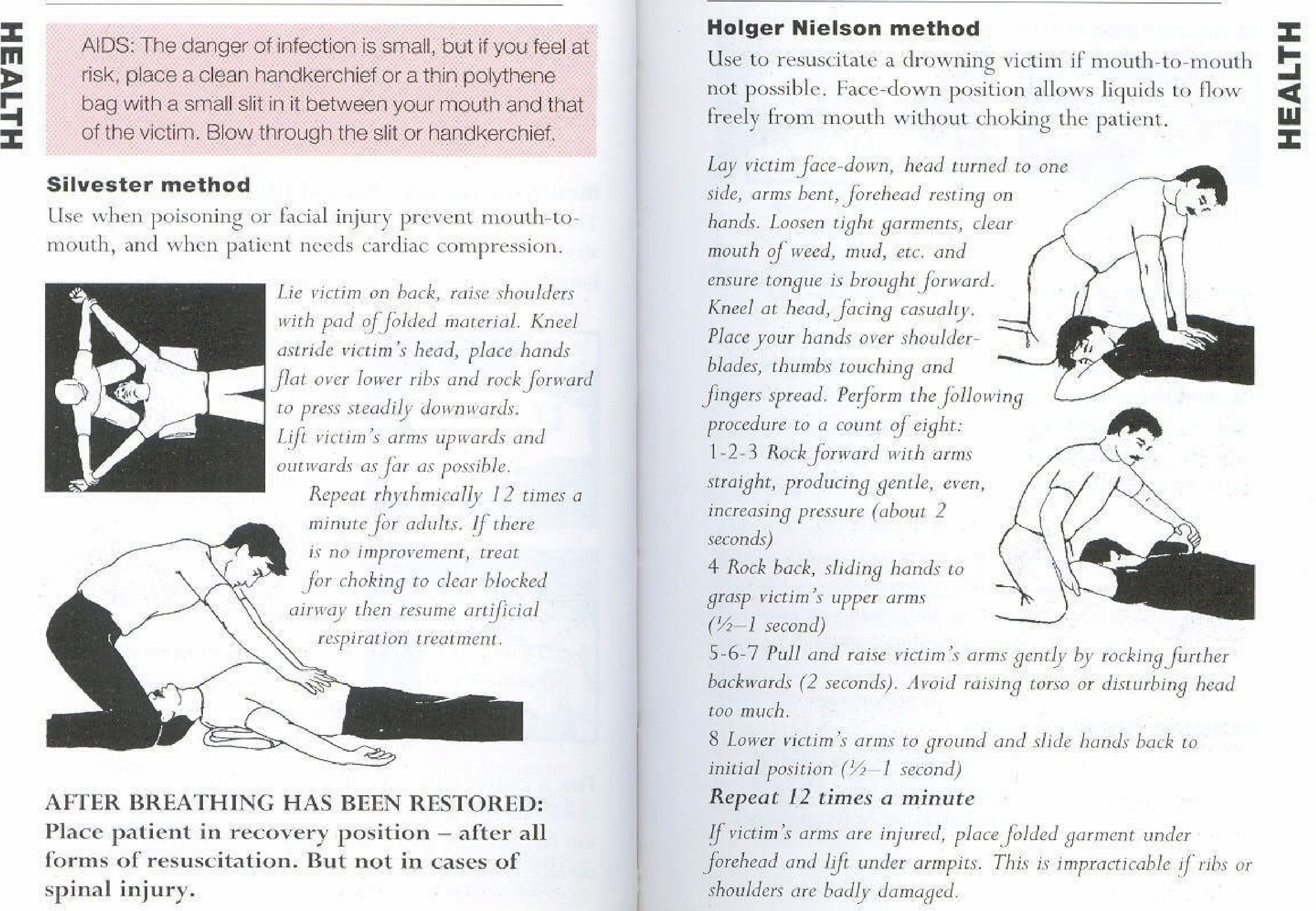
Holger Nielson Method of Respiration: Use to resuscitate a drowning victim if mouth to mouth not possible. Face-down position allows liquids to flow freely from mouth without choking the patient. Lay victim face-down, head turned to one side, arms bent, forehead resting on hands. Loosen tight garments, clear mouth of weed, mud etc and ensure tongue is brought forward.
SAS 141 – First Aid & Choking
Related posts:
PS Family Disaster Plan (6)
Learn the types of natural disasters in your region. Local Emergency management or civil denense officials can identify which disasters are most liekly to hit your community.Identify which human-caused or technological disasters can affect your region
Learn the types of natural disasters in your region. Local Emergency management or civil denense officials can identify which disasters are most liekly to hit your community.Identify which human-caused or technological disasters can affect your region
SAS 122 - Sea Survival & Abandoning Ships
Survival at Sea: Four-Fifths of the Earth's surface is open water - the most difficult environment in which to survive. Water and wind rapidly chill the body. Alone in cold water your chances are not good without equipment. If you know your location you may be able to predict where the currents will carry you.
Survival at Sea: Four-Fifths of the Earth's surface is open water - the most difficult environment in which to survive. Water and wind rapidly chill the body. Alone in cold water your chances are not good without equipment. If you know your location you may be able to predict where the currents will carry you.
SAS 095 - Camp Tools & Beds
Beds: Avoid lying on cold, damp ground. In the tropics raise the bed to provide a current of air. In cold climates, Keep a fire going through the night and build a screen to reflect heat back on your sleeping area. On dry ground, stones heated in the fire and then buried under a thin layer of soil beneath the bedding will keep you warm.
Beds: Avoid lying on cold, damp ground. In the tropics raise the bed to provide a current of air. In cold climates, Keep a fire going through the night and build a screen to reflect heat back on your sleeping area. On dry ground, stones heated in the fire and then buried under a thin layer of soil beneath the bedding will keep you warm.
SAS 108 - Map Reading & Direction Finding
Direction Finding: The sun rises the eas and sets in the west, roughly speaking. In the northern hemisphere, at noon, the sun will be due south; in the southern hemisphere it will be due north. The hemisphere is indicated by the way shadows move: clockwise in the north, anti-clockwise in the south.
Direction Finding: The sun rises the eas and sets in the west, roughly speaking. In the northern hemisphere, at noon, the sun will be due south; in the southern hemisphere it will be due north. The hemisphere is indicated by the way shadows move: clockwise in the north, anti-clockwise in the south.
SAS 121 - Moving on Water
Crossing with Ropes: You need a loop of rope three times as long as the width of the stream and at least three people in the party- the fittest person crosses while two control the rope to keep it out of the water as much as possible, and stand by to haul the crosser to safety if difficulties are encountered.
Crossing with Ropes: You need a loop of rope three times as long as the width of the stream and at least three people in the party- the fittest person crosses while two control the rope to keep it out of the water as much as possible, and stand by to haul the crosser to safety if difficulties are encountered.
SAS 032 - Edible Plants
Many herbs grow wild. Most can be dried, but not in direct sunlight.
Many herbs grow wild. Most can be dried, but not in direct sunlight.
SAS 097 - Clothing & Ropes
Taking care of Rope: Rope should be protected from exposure to damp or storing sunlight and if made from natural fibres, from attack by rodents and insects. If it does get wet, do not force dry it in front of a fire. Do not drag it or leave it on the ground. Dirt can penetrate and work away at the fibres.
Taking care of Rope: Rope should be protected from exposure to damp or storing sunlight and if made from natural fibres, from attack by rodents and insects. If it does get wet, do not force dry it in front of a fire. Do not drag it or leave it on the ground. Dirt can penetrate and work away at the fibres.
SAS 158 - Diseases & Natural Medicine
Natural medicine or Natural remedies can be used when medical supplies are exhausted, or to supplement your store. Urine can be used as an antiseptic to wash out wounds. Maggots will keep a wound open and clean until better treatment can be given.
Natural medicine or Natural remedies can be used when medical supplies are exhausted, or to supplement your store. Urine can be used as an antiseptic to wash out wounds. Maggots will keep a wound open and clean until better treatment can be given.
SAS 152 - First Aid & Moving the Injured
During the conscious casuality of the victim, Grasp victim's right wrist. Bend your head under his arm so your shoulder is level with his lower abdomen. Bend your knees, allowing the weight to fall across your shoulders. Place your right arm between or around legs.
During the conscious casuality of the victim, Grasp victim's right wrist. Bend your head under his arm so your shoulder is level with his lower abdomen. Bend your knees, allowing the weight to fall across your shoulders. Place your right arm between or around legs.
SAS 114 - Reading Weather with Clouds
There are different types of clouds that needs to be read to read the signs. They are Cirrus Clouds, Cirrostratus clouds, Altostratus clouds, Nimbostratus clouds, Stratocumulus clouds, Stratus clouds.
There are different types of clouds that needs to be read to read the signs. They are Cirrus Clouds, Cirrostratus clouds, Altostratus clouds, Nimbostratus clouds, Stratocumulus clouds, Stratus clouds.
SAS 113 - Reading Weather with Clouds
Clouds are the most reliable of weather signs. There are ten main types of cloud formation. Approximate altitudes are given for each type. THe same shapes occur at lower altitutudes in polar regions.
Clouds are the most reliable of weather signs. There are ten main types of cloud formation. Approximate altitudes are given for each type. THe same shapes occur at lower altitutudes in polar regions.
SAS 098 - Ropes & Knots
It is important to select the right know for the task in hand. You never know when you may need to tie a knot, so learn their uses and how to tie - and untie each one.
It is important to select the right know for the task in hand. You never know when you may need to tie a knot, so learn their uses and how to tie - and untie each one.
SAS 143 - First Aid, CPR & Bleeding
Arterial bleeding: Speed is vital in stopping blood spurting from an artery. Compress the artery at pressure points where it runs ear the surface over a bone. Watch the wound: if blood flow does not lessen, move your fingers until it does.
Arterial bleeding: Speed is vital in stopping blood spurting from an artery. Compress the artery at pressure points where it runs ear the surface over a bone. Watch the wound: if blood flow does not lessen, move your fingers until it does.
SAS 048 - Animal Tracking
Wild cats occur on all continents except Australia and Antarctica, but not common. Secretive and generally nocturnal. Kills of big cats may be scavenged if unatteded, but beware of big cats. Small cat meat is like rabbit. Stew thoroughly.
Wild cats occur on all continents except Australia and Antarctica, but not common. Secretive and generally nocturnal. Kills of big cats may be scavenged if unatteded, but beware of big cats. Small cat meat is like rabbit. Stew thoroughly.
SAS 184 - Disaster Strategy & Vehicles
Transport has an important role to play in disaster strategy. Make sure you know how to get the best use out of your vehicle in any situation. If you are trapped in a blizzard, stay in the car. If you are on a regular traffic route you will probably soon be rescued. Going for help could be too risky.
Transport has an important role to play in disaster strategy. Make sure you know how to get the best use out of your vehicle in any situation. If you are trapped in a blizzard, stay in the car. If you are on a regular traffic route you will probably soon be rescued. Going for help could be too risky.
SAS 102 - Knots
Tie the same number stepping stools as manharness hitches in a rope as you need hand and toeholds. An arrangement of overhand hitches tied at interims in a smooth rope will make climbing it much less demanding.
Tie the same number stepping stools as manharness hitches in a rope as you need hand and toeholds. An arrangement of overhand hitches tied at interims in a smooth rope will make climbing it much less demanding.
How to Jump from a Moving Car
Flinging yourself from a moving auto ought to be a final resort, for instance if your brakes are flawed and your auto is going to take off a bluff or into an entourage. Apply the crisis brake. This should not stop the auto, at the same time it may back it off enough to make bouncing safer.
Flinging yourself from a moving auto ought to be a final resort, for instance if your brakes are flawed and your auto is going to take off a bluff or into an entourage. Apply the crisis brake. This should not stop the auto, at the same time it may back it off enough to make bouncing safer.
SAS 145 - First Aid & Wounds
Soap is an antiseptic: use to wash wounds. Wash hands in boiled water before cleaning wound. Wash wound in boiled water or if none is available use urine, which is sterile and will not introduce infection.
Soap is an antiseptic: use to wash wounds. Wash hands in boiled water before cleaning wound. Wash wound in boiled water or if none is available use urine, which is sterile and will not introduce infection.
 Upload your infographic here and contribute to our community.

Leave a Reply