
Stay in a Vehicle: Do not try to drive through thick smoke. If caught in a fire in a vehicle, park in a clear area. Pull off the road, but do not risk getting bogged down. Turn on the headlights and stay inside the car. Wind windows tightly shut.
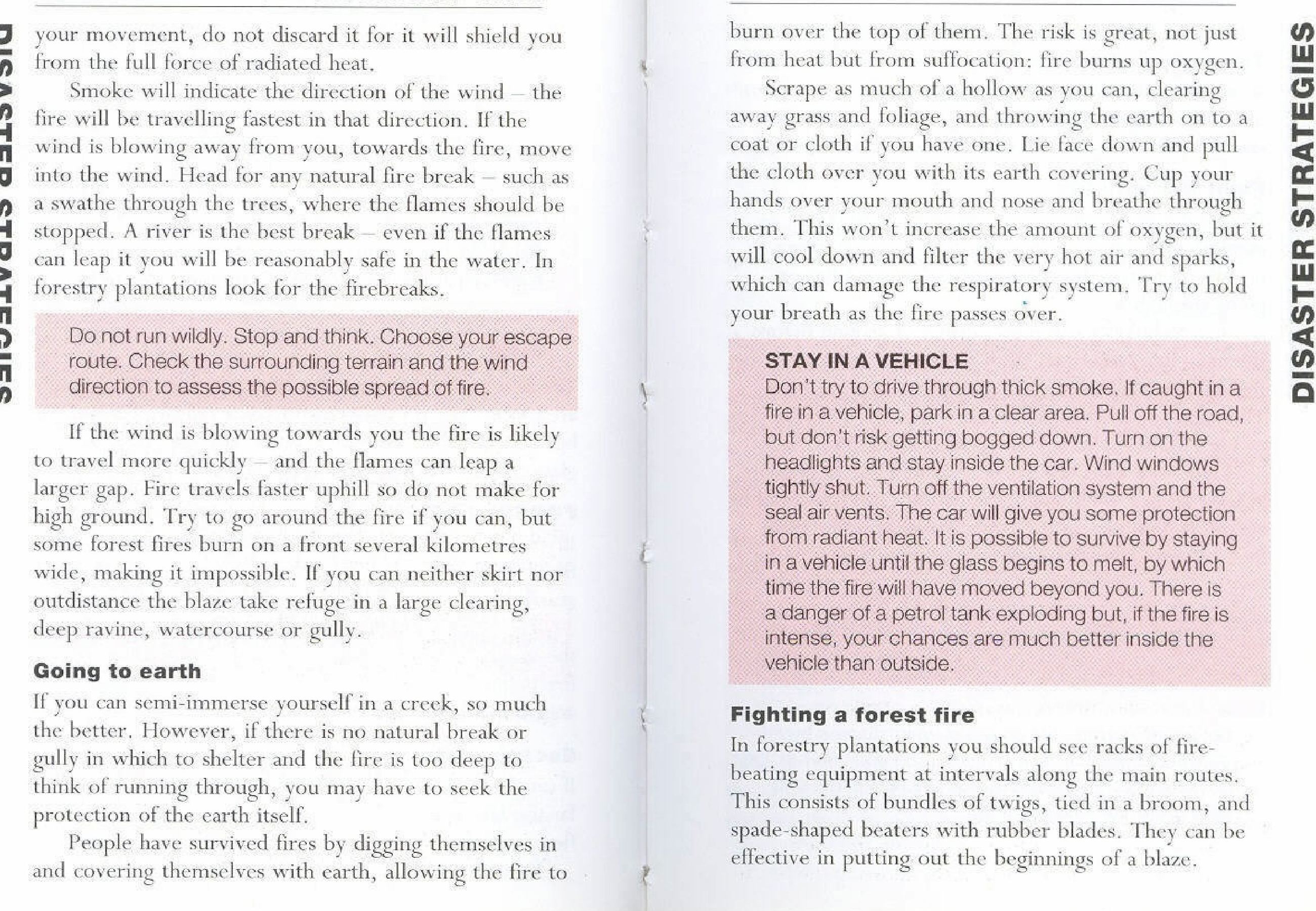
SAS 174 – Disaster Strategy & Fire
Related posts:
SAS 124 - Sea Survival
Survival Afloat: Rafts, boats and dinghies are built to carry a limited number. These numbers should not be exceeded. Place infants and the infirm aboard, and as many able-boclied as can be accomodated. The rest must hang on in the water, frequently swopping places with fit survivors in the raft.
Survival Afloat: Rafts, boats and dinghies are built to carry a limited number. These numbers should not be exceeded. Place infants and the infirm aboard, and as many able-boclied as can be accomodated. The rest must hang on in the water, frequently swopping places with fit survivors in the raft.
SAS 123 - Sea Survival
Swim slowly and steadily. If abandoning a sinking boat or aircraft get upwind and stay clear of it. Keep away from any fuel slick. If forced to swim through flames, jump in feet first and up wind. Swim into the wind using breast stroke. Splash flames away from head to make breathing holes.
Swim slowly and steadily. If abandoning a sinking boat or aircraft get upwind and stay clear of it. Keep away from any fuel slick. If forced to swim through flames, jump in feet first and up wind. Swim into the wind using breast stroke. Splash flames away from head to make breathing holes.
SAS 043 - Desert & Tropical Plants
Growing tip, enclosed by crown of leaves or bases of leaf stems, is edible in most palms - eat if not too bitter. Avoid fruit unless positively identified.
Growing tip, enclosed by crown of leaves or bases of leaf stems, is edible in most palms - eat if not too bitter. Avoid fruit unless positively identified.
PS Family Disaster Plan (6)
Learn the types of natural disasters in your region. Local Emergency management or civil denense officials can identify which disasters are most liekly to hit your community.Identify which human-caused or technological disasters can affect your region
Learn the types of natural disasters in your region. Local Emergency management or civil denense officials can identify which disasters are most liekly to hit your community.Identify which human-caused or technological disasters can affect your region
PS Emergency Preparedness Checklist (1)
Whenever fiasco strikes, you should not have much chance to act. Plan now for a sudden crisis. Memorize how to ensure your self and adapt to any sort of debacle by arranging ahead.
Whenever fiasco strikes, you should not have much chance to act. Plan now for a sudden crisis. Memorize how to ensure your self and adapt to any sort of debacle by arranging ahead.
PS Family Supply Kit (4)
First of all, find out which disaster are most likely to happen in your community. Ask how you would be warned. Find out how to prepare for each. Meet with the family ad discuss the type of disasters that could happen.
First of all, find out which disaster are most likely to happen in your community. Ask how you would be warned. Find out how to prepare for each. Meet with the family ad discuss the type of disasters that could happen.
SAS 143 - First Aid, CPR & Bleeding
Arterial bleeding: Speed is vital in stopping blood spurting from an artery. Compress the artery at pressure points where it runs ear the surface over a bone. Watch the wound: if blood flow does not lessen, move your fingers until it does.
Arterial bleeding: Speed is vital in stopping blood spurting from an artery. Compress the artery at pressure points where it runs ear the surface over a bone. Watch the wound: if blood flow does not lessen, move your fingers until it does.
Explosive Standards
An explosive material, in addition called a hazardous, is a reactive substance that holds a noteworthy measure of potential force that can handle an eruption if discharged suddenly, regularly went hand in hand with by the handling of light, high temperature, sound, and force. A hazardous charge is a measured amount of hazardous material.
An explosive material, in addition called a hazardous, is a reactive substance that holds a noteworthy measure of potential force that can handle an eruption if discharged suddenly, regularly went hand in hand with by the handling of light, high temperature, sound, and force. A hazardous charge is a measured amount of hazardous material.
SAS 118 - Moving
Negotiating territory at night can be dangerous, but may be necessary. Because it is difficult to see clearly you are easily disorientated. It is always darker among trees, so keep to open country if you can. When looking at an object at night, look at one side rather than directly at it. It is hard to distinguish anything in a dark mass, but edges show clearly.
Negotiating territory at night can be dangerous, but may be necessary. Because it is difficult to see clearly you are easily disorientated. It is always darker among trees, so keep to open country if you can. When looking at an object at night, look at one side rather than directly at it. It is hard to distinguish anything in a dark mass, but edges show clearly.
SAS 175 - Disaster Strategy & Fire
Escaping through fire: Sometimes the best escape route may be to run through the flames. This is impossible if they are very intense and the area covered by thefire is great. In a large clearing or on heath land, however, it may be possible to run through less dense fire to refuge on the already burned-out land.
Escaping through fire: Sometimes the best escape route may be to run through the flames. This is impossible if they are very intense and the area covered by thefire is great. In a large clearing or on heath land, however, it may be possible to run through less dense fire to refuge on the already burned-out land.
Finding Direction
Direction finding points to the foundation of the course from which an appropriated sign was transmitted. This can point to radio or different manifestations of satellite correspondence. By joining together the bearing qualified information from two or suitably divided recipients (or a lone portable recipient), the root of a transmission may be found in space through triangulation.
Direction finding points to the foundation of the course from which an appropriated sign was transmitted. This can point to radio or different manifestations of satellite correspondence. By joining together the bearing qualified information from two or suitably divided recipients (or a lone portable recipient), the root of a transmission may be found in space through triangulation.
SAS 171 - Dangerous Water Creatures
Porcupine fish, Puffer fish, TriggerFish are very poisonous to eat. They differ somewhat in appearance, but when alarmed all inflate into a spiny ball. The flesh of these animals is poisonous.
Porcupine fish, Puffer fish, TriggerFish are very poisonous to eat. They differ somewhat in appearance, but when alarmed all inflate into a spiny ball. The flesh of these animals is poisonous.
SAS 109 - Direction Finding
Direction by Watch: a traditional analogue watch with two hands can tell direction, provided it is set to true local time. The nearer the Equator you are, the less accurate this method is.
Direction by Watch: a traditional analogue watch with two hands can tell direction, provided it is set to true local time. The nearer the Equator you are, the less accurate this method is.
SAS 121 - Moving on Water
Crossing with Ropes: You need a loop of rope three times as long as the width of the stream and at least three people in the party- the fittest person crosses while two control the rope to keep it out of the water as much as possible, and stand by to haul the crosser to safety if difficulties are encountered.
Crossing with Ropes: You need a loop of rope three times as long as the width of the stream and at least three people in the party- the fittest person crosses while two control the rope to keep it out of the water as much as possible, and stand by to haul the crosser to safety if difficulties are encountered.
SAS 029 - Food
Gathering plants is one of the tedious tasks to identify place for food. Gather plants systematically. Take a container on foraging trips to stp the harvest being crushed, which makes it go off.
Gathering plants is one of the tedious tasks to identify place for food. Gather plants systematically. Take a container on foraging trips to stp the harvest being crushed, which makes it go off.
SAS 131 - Rescue & Signalling
By day smoke is good locator. Have a supply of smoke-producing material ready to put on your fires. Smoke not only helps rescue aircraft find you, it also shows surface wind direction. Make sure smoke is downwind of landing site and of any panel codes you have laid so it does not obscure them from above.
By day smoke is good locator. Have a supply of smoke-producing material ready to put on your fires. Smoke not only helps rescue aircraft find you, it also shows surface wind direction. Make sure smoke is downwind of landing site and of any panel codes you have laid so it does not obscure them from above.
SAS 047 - Seaweed & Animal Tracking
Seaweeds occur anchored tot bottom in shallow waters, or floating on open sea. Coastal weeds are often stratified: green forms grow in surface waters, red in shallow water, brown a little deeper. Wash seaweeds in freshwater before eating, to remove salt. If you can read the subtle signs that animals leave, you will know what hunting/trapping methods to use. Only large, powerful mammals ventur...
Seaweeds occur anchored tot bottom in shallow waters, or floating on open sea. Coastal weeds are often stratified: green forms grow in surface waters, red in shallow water, brown a little deeper. Wash seaweeds in freshwater before eating, to remove salt. If you can read the subtle signs that animals leave, you will know what hunting/trapping methods to use. Only large, powerful mammals ventur...
SAS 125 - Sea Survival & Signalling
How to Signal at Sea ? Use flares, dye markers and movement of any kind to attract attention at sea. If you have no signalling equipment, wave clothing or tarpauliins and churn the water if it is still. At night or in fog use a whistle to maintain contact with other survivors.
How to Signal at Sea ? Use flares, dye markers and movement of any kind to attract attention at sea. If you have no signalling equipment, wave clothing or tarpauliins and churn the water if it is still. At night or in fog use a whistle to maintain contact with other survivors.
 Upload your infographic here and contribute to our community.
Leave a Reply