
Gouge a small depression at a near end of baseboard. Cut a cavity below for tiner. Shape the spindle evenly. Make a bow from a pliable shoot and hide, twine or a bootlace. Use hollow piece of stone wood to steady top of the spindle and exert downloard pressure. Wind bowstring once round spindle.
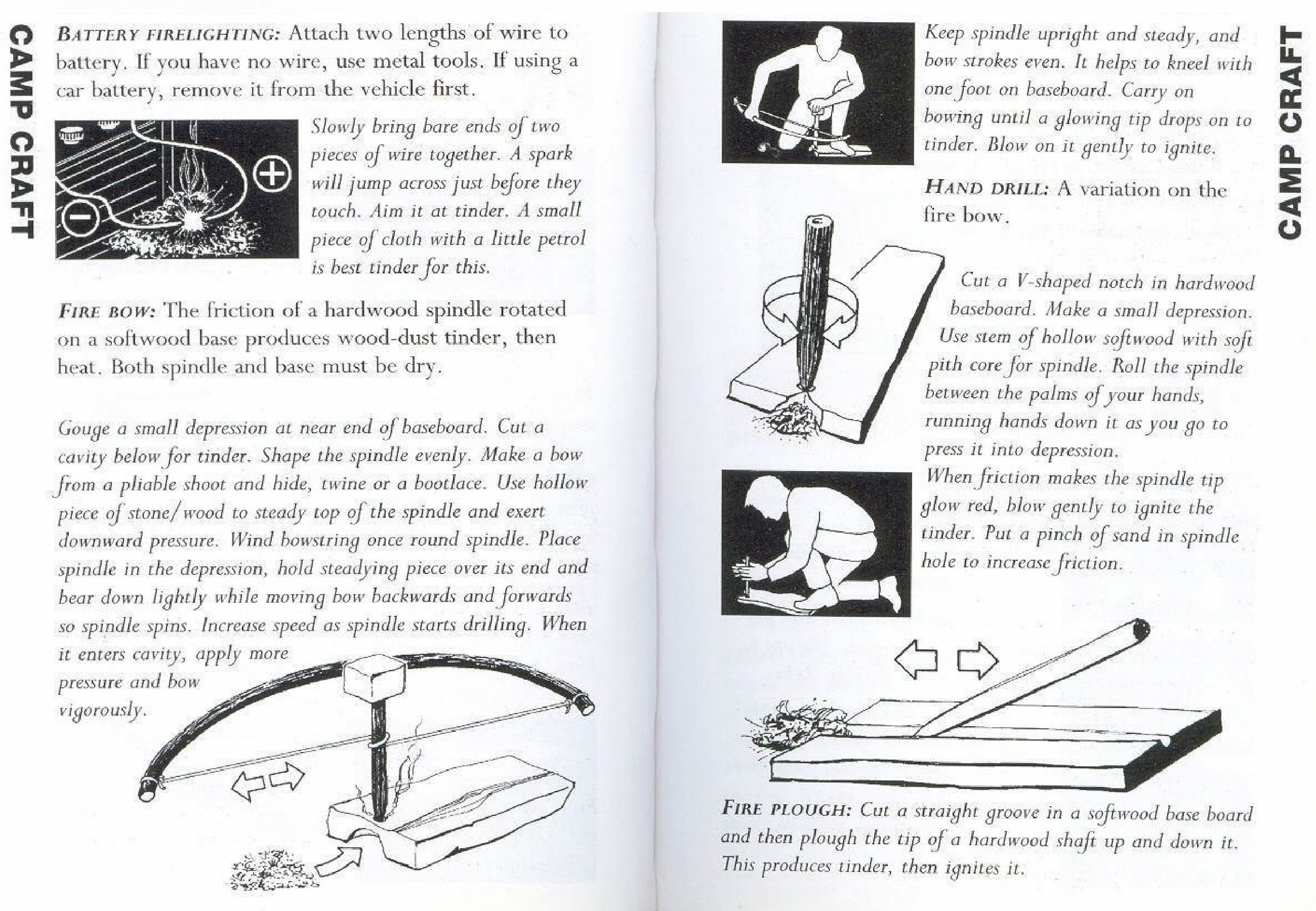
SAS 084 – Fire
Related posts:
SAS 157 - Diseases
Some of the cold climate hazards are Hypothermia. Loss of temperature due to exposure, brought on by exhaustion, inadequate clothing or shelter, lack of food, lack of knowledge and preperation. Wet clothing or immersion in cold water will aggravate it, as will anxiety, stress and injuries that immobilise.
Some of the cold climate hazards are Hypothermia. Loss of temperature due to exposure, brought on by exhaustion, inadequate clothing or shelter, lack of food, lack of knowledge and preperation. Wet clothing or immersion in cold water will aggravate it, as will anxiety, stress and injuries that immobilise.
SAS 090 - Preserving Food
If food is not plentiful or is limited by season, ensure that stores keep safely. Do not store food in direct sunlight, near excessive warmth or moisture, nor where scavengers may ruin it.
If food is not plentiful or is limited by season, ensure that stores keep safely. Do not store food in direct sunlight, near excessive warmth or moisture, nor where scavengers may ruin it.
SAS 121 - Moving on Water
Crossing with Ropes: You need a loop of rope three times as long as the width of the stream and at least three people in the party- the fittest person crosses while two control the rope to keep it out of the water as much as possible, and stand by to haul the crosser to safety if difficulties are encountered.
Crossing with Ropes: You need a loop of rope three times as long as the width of the stream and at least three people in the party- the fittest person crosses while two control the rope to keep it out of the water as much as possible, and stand by to haul the crosser to safety if difficulties are encountered.
SAS 095 - Camp Tools & Beds
Beds: Avoid lying on cold, damp ground. In the tropics raise the bed to provide a current of air. In cold climates, Keep a fire going through the night and build a screen to reflect heat back on your sleeping area. On dry ground, stones heated in the fire and then buried under a thin layer of soil beneath the bedding will keep you warm.
Beds: Avoid lying on cold, damp ground. In the tropics raise the bed to provide a current of air. In cold climates, Keep a fire going through the night and build a screen to reflect heat back on your sleeping area. On dry ground, stones heated in the fire and then buried under a thin layer of soil beneath the bedding will keep you warm.
SAS 016 - Hunting
While Hunting and trapping, Tracks in snow are easy to follow, but leave a trail of bright flags to guide you back to base. Make them high enough not to be covered by a fresh snowfall.Bleed, gut and skin while careass is warm. Roll hides before they freeze.Frostible hypothermia and snow blindness are the main hazards.
While Hunting and trapping, Tracks in snow are easy to follow, but leave a trail of bright flags to guide you back to base. Make them high enough not to be covered by a fresh snowfall.Bleed, gut and skin while careass is warm. Roll hides before they freeze.Frostible hypothermia and snow blindness are the main hazards.
SAS 109 - Direction Finding
Direction by Watch: a traditional analogue watch with two hands can tell direction, provided it is set to true local time. The nearer the Equator you are, the less accurate this method is.
Direction by Watch: a traditional analogue watch with two hands can tell direction, provided it is set to true local time. The nearer the Equator you are, the less accurate this method is.
SAS 070 - Fishing
Huge fish might be gotten in a noose line settled to the finish of a post, or passed down within a length of bamboo. Pass circle over fish from tail close and force up sharply so that the noose traps fish.
Huge fish might be gotten in a noose line settled to the finish of a post, or passed down within a length of bamboo. Pass circle over fish from tail close and force up sharply so that the noose traps fish.
SAS 047 - Seaweed & Animal Tracking
Seaweeds occur anchored tot bottom in shallow waters, or floating on open sea. Coastal weeds are often stratified: green forms grow in surface waters, red in shallow water, brown a little deeper. Wash seaweeds in freshwater before eating, to remove salt. If you can read the subtle signs that animals leave, you will know what hunting/trapping methods to use. Only large, powerful mammals ventur...
Seaweeds occur anchored tot bottom in shallow waters, or floating on open sea. Coastal weeds are often stratified: green forms grow in surface waters, red in shallow water, brown a little deeper. Wash seaweeds in freshwater before eating, to remove salt. If you can read the subtle signs that animals leave, you will know what hunting/trapping methods to use. Only large, powerful mammals ventur...
SAS 179 - Disaster Strategy & Hurricane
A hurricane is a wind of high speed - above force 12 on the Beaufort scale - which brings torrential rain and can destroy any flimsy structures. It is a tropical form of cyclone, which in more temperate latitudes would be prevented from developing in the upper levels of the air by the prevailing westerly winds.
A hurricane is a wind of high speed - above force 12 on the Beaufort scale - which brings torrential rain and can destroy any flimsy structures. It is a tropical form of cyclone, which in more temperate latitudes would be prevented from developing in the upper levels of the air by the prevailing westerly winds.
SAS 119 - Moving on Waterways
A wide river will be easier to float on than to walk beside. Long-term survivors should experiment with making canoes by burning out the centre of a tree trunk or covering a frame of willow with birch bark or skins.
A wide river will be easier to float on than to walk beside. Long-term survivors should experiment with making canoes by burning out the centre of a tree trunk or covering a frame of willow with birch bark or skins.
SAS 150 - First Aid & Bandaging
Never join bandages with knots. Anchor separate strips by binding over a previously applied layer. Tie finishing knots over uninjured side or limb. Use knots which are easily untied and easily accessible.
Never join bandages with knots. Anchor separate strips by binding over a previously applied layer. Tie finishing knots over uninjured side or limb. Use knots which are easily untied and easily accessible.
SAS 058 - Animal Trapping
A deadfall is an ample shake or log that is tilted on a plot and kept up with areas of limbs (stays), with one of them that serves as a trigger. When the creature moves the trigger which may have trap on or close it, the rock or log falls, pounding the creature. The figure-four dead fall is an in vogue and basic trap built from materials recognized in the hedge.
A deadfall is an ample shake or log that is tilted on a plot and kept up with areas of limbs (stays), with one of them that serves as a trigger. When the creature moves the trigger which may have trap on or close it, the rock or log falls, pounding the creature. The figure-four dead fall is an in vogue and basic trap built from materials recognized in the hedge.
SAS 101 - Knots
Triple Bowline: A bowline made with a twofold line. Structure a circle, pass copied exist close through circle, betraying standing part and trust through circle. This produces 3 circles which could be utilized for supplies haulage, or as asit-sling or lifting saddle with one circle adjust every thigh and the different adjust the midsection.
Triple Bowline: A bowline made with a twofold line. Structure a circle, pass copied exist close through circle, betraying standing part and trust through circle. This produces 3 circles which could be utilized for supplies haulage, or as asit-sling or lifting saddle with one circle adjust every thigh and the different adjust the midsection.
SAS 100 - Knots
Fisherman’s knot is the perfect hitch for uniting springy vines, wires, dangerous lines and gut throwing a baited hook out there line. Particularly secure but difficult to untie. Not prescribed for cumbersome ropes or nylon line. Twofold angler's stronger adaptation of the above. don't utilize for nylon casting a line out there lines, nylon ropes, or massive ropes.
Fisherman’s knot is the perfect hitch for uniting springy vines, wires, dangerous lines and gut throwing a baited hook out there line. Particularly secure but difficult to untie. Not prescribed for cumbersome ropes or nylon line. Twofold angler's stronger adaptation of the above. don't utilize for nylon casting a line out there lines, nylon ropes, or massive ropes.
SAS 175 - Disaster Strategy & Fire
Escaping through fire: Sometimes the best escape route may be to run through the flames. This is impossible if they are very intense and the area covered by thefire is great. In a large clearing or on heath land, however, it may be possible to run through less dense fire to refuge on the already burned-out land.
Escaping through fire: Sometimes the best escape route may be to run through the flames. This is impossible if they are very intense and the area covered by thefire is great. In a large clearing or on heath land, however, it may be possible to run through less dense fire to refuge on the already burned-out land.
SAS 093 - Camp Tools
Camp tools that are used in the camp craft are the Stone Tools, BOne tools, the axes.
Camp tools that are used in the camp craft are the Stone Tools, BOne tools, the axes.
Surviving a Thunderstorm
To survive from a thunderstorm, do not take cover under the tree's or any other wooden structure. If struck by lightning, they will effectively explode and you will be trapped under a fiery tree of death. On top of that, you will probably have quite a few big splinters.
To survive from a thunderstorm, do not take cover under the tree's or any other wooden structure. If struck by lightning, they will effectively explode and you will be trapped under a fiery tree of death. On top of that, you will probably have quite a few big splinters.
SAS 118 - Moving
Negotiating territory at night can be dangerous, but may be necessary. Because it is difficult to see clearly you are easily disorientated. It is always darker among trees, so keep to open country if you can. When looking at an object at night, look at one side rather than directly at it. It is hard to distinguish anything in a dark mass, but edges show clearly.
Negotiating territory at night can be dangerous, but may be necessary. Because it is difficult to see clearly you are easily disorientated. It is always darker among trees, so keep to open country if you can. When looking at an object at night, look at one side rather than directly at it. It is hard to distinguish anything in a dark mass, but edges show clearly.
 Upload your infographic here and contribute to our community.
Leave a Reply